Stress and anxiety can make you feel like your own body is working against you.
You may know, logically, that you are safe. You may tell yourself to calm down. You may even understand exactly why you are stressed.
And yet your chest still tightens. Your thoughts still race. Your stomach still twists. Your body still feels like it is preparing for something, even when nothing is actually happening in the moment.
That is because stress and anxiety are not just thoughts. They are body responses. They are nervous system patterns. And sometimes, trying to “think” your way out of them only makes you feel more frustrated.
Self hypnosis for stress and anxiety offers a different approach.
Instead of forcing yourself to calm down, self-hypnosis gently guides your mind and body into a more relaxed, focused state. From there, you can begin practicing calm, releasing tension, and giving your subconscious mind new suggestions to respond differently.
It is not magic. It is not mind control. And you do not have to be “good” at hypnosis for it to help.
It is simply a way to work with your mind and body instead of fighting against them.
Quick Answer: What Is Self Hypnosis for Stress and Anxiety?
I created a free hypnosis audio to help you begin calming your mind and body gently. You can listen when you are in a quiet, safe place and simply allow yourself to be guided.
Get the free hypnosis audio for stress and anxiety.
Self hypnosis for stress and anxiety is a self-guided relaxation audio and focus practice that helps calm the nervous system, quiet racing thoughts, relax the body, and introduce supportive suggestions to the subconscious mind.
During self-hypnosis, you remain aware and in control. You are not asleep. You are not unconscious. You are simply allowing your attention to narrow, your body to soften, and your mind to become more open to calming suggestions.
Self-hypnosis can be used as a daily stress relief practice, a calming tool before sleep, or a way to help your body rehearse a new response to anxiety.
Why Stress and Anxiety Can Feel So Hard to “Think” Your Way Out Of
One of the most frustrating parts of anxiety is that it does not always respond to logic.
You can tell yourself:
“I’m fine.”
“Nothing bad is happening.”
“There is no reason to feel this way.”
“I should be able to calm down.”
But your body may still feel tense, alert, restless, or overwhelmed.
That does not mean you are failing. It means the part of you reacting is not only working from logic. It is working from pattern, memory, emotion, expectation, and protection.
Stress and anxiety often show up through the body before the conscious mind fully understands what is happening.
You may notice:
- Racing thoughts
- Shallow breathing
- Tightness in the chest
- Tension in the jaw, shoulders, or stomach
- Trouble sleeping
- Feeling restless or on edge
- Difficulty relaxing
- Overthinking simple decisions
- Feeling like something is wrong, even when nothing obvious happened
This is why telling yourself to calm down does not always work.
The part of you reacting is not trying to make your life harder. It is trying to protect you. It may simply be using an outdated response, an overactive response, or a response that no longer fits the present moment.
Self-hypnosis helps because it gives your nervous system a different experience.
Instead of arguing with anxiety, you guide the body toward safety.
Instead of fighting racing thoughts, you give the mind one calm place to focus.
Instead of forcing change, you create conditions where change feels more possible.
What Is Self-Hypnosis?
Self-hypnosis is a relaxed, focused state that you guide yourself into intentionally.
You may have already experienced natural hypnotic states without realizing it.
For example, have you ever driven somewhere familiar and arrived without remembering every turn? Have you ever been so absorbed in a book, movie, or creative project that time seemed to pass differently? Have you ever stared out the window and drifted into a quiet, inward place?
Those are everyday examples of focused attention.
Self-hypnosis uses that natural ability on purpose.
When you practice self-hypnosis, you gently narrow your attention. You relax the body. You slow the breath. You use imagery, words, sensations, or suggestions to guide your inner experience.
It is not about forcing your mind to go blank.
It is about giving your mind one calm direction to follow.
For stress and anxiety, that direction may be:
“I am safe enough in this moment.”
“My body can soften.”
“I can breathe through this.”
“I do not have to solve everything right now.”
“My nervous system can learn calm again.”
Self-Hypnosis vs. Meditation
Self-hypnosis and meditation can feel similar, but they are not exactly the same.
Meditation often focuses on awareness. You may observe your thoughts, notice your breath, or practice being present without judgment.
Self-hypnosis is usually more goal-directed. You enter a relaxed, focused state with a specific intention, such as reducing stress, easing anxiety, sleeping better, building confidence, or changing a habit.
Both can be helpful.
The difference is that self-hypnosis often includes suggestions. These suggestions are simple, supportive statements that help your subconscious mind begin practicing a new response.
For example, in meditation you might notice, “My shoulders are tense.”
In self-hypnosis, you might notice the tension and then gently suggest, “My shoulders can release now. My body is allowed to soften.”
That may sound simple, but the subconscious mind often responds well to repetition, imagery, emotion, and felt experience.
Self-Hypnosis vs. Guided Hypnosis With a Hypnotist
Self-hypnosis is something you can practice on your own. It can be a beautiful tool for daily stress relief, emotional regulation, and reconnecting with your body.
Guided hypnosis with a hypnotist is more personalized.
When you work with a trained hypnotist, the session can be tailored to your specific patterns, triggers, beliefs, and goals. You do not have to come up with the right words or guide yourself through the process. You can simply follow the experience and allow the practitioner to help you explore what is happening beneath the surface.
Self-hypnosis can help you practice calm.
Guided hypnosis can help you understand and shift the deeper patterns that may be keeping stress and anxiety active.
Both have value.
The best starting place depends on what you need.
If you are looking for a simple way to begin calming your mind and body, self-hypnosis is a gentle first step. If your anxiety feels persistent, layered, or connected to deeper emotional patterns, guided hypnosis may be more supportive.
Does Self Hypnosis Really Help With Stress and Anxiety?
Self-hypnosis may help many people reduce stress and anxiety by calming the body, focusing the mind, and creating a more relaxed internal state.
It is important to be realistic, though.
Self-hypnosis is not a magic cure. It does not erase every stressful situation from your life. It does not replace medical care, therapy, or mental health treatment when those are needed.
What it can do is help you build a different relationship with your stress response.
It can help you pause.
It can help you breathe.
It can help you soften tension.
It can help you stop feeding anxious thoughts with more anxious thoughts.
It can help your body remember that calm is possible.
And for many people, that is a powerful place to begin.
What I See With Clients
Many people come to hypnosis because there is a gap between what they know and what they feel.
They might say something like:
“I know I’m safe, but my body does not believe it.”
Or:
“I understand why I’m anxious, but I still cannot stop the feeling.”
That gap is exactly where hypnosis can be helpful.
Hypnosis works with the part of the mind that responds to imagery, emotion, repetition, memory, and suggestion. It gives the body and subconscious mind a new experience, not just a new explanation.
That matters because stress and anxiety are often not only about what is happening now. They can also be connected to old patterns, old expectations, emotional conditioning, or the nervous system becoming used to staying on alert.
Self-hypnosis gives you a way to begin interrupting that pattern gently.
How Self-Hypnosis Calms Stress and Anxiety
Self-hypnosis can support stress and anxiety in several ways.
It Slows the Breath
When you are stressed or anxious, your breathing often becomes shallow or fast.
This can send the body more signals that something is wrong.
During self-hypnosis, you intentionally slow the breath. Longer exhales can help the body begin shifting out of a high-alert state and into a calmer rhythm.
You are not forcing calm.
You are giving the body a signal of safety.
It Relaxes the Body
Stress often lives in the body.
You may carry it in your jaw, shoulders, chest, stomach, hands, or back.
Self-hypnosis often includes body relaxation, such as slowly softening each area of the body. This helps you notice where tension is being held and begin releasing it.
Sometimes people do not realize how tense they are until they are guided to relax.
It Gives the Mind a Calm Focus
An anxious mind tends to jump from one thought to the next.
What if this happens?
What if that goes wrong?
What if I cannot handle it?
What if I never feel better?
Self-hypnosis gives the mind something calmer to follow.
That may be your breath, a peaceful image, a count, a word, or a suggestion.
The goal is not to never have thoughts.
The goal is to stop letting every thought pull you in a different direction.
It Uses Supportive Suggestions
In hypnosis, suggestions are positive, intentional statements that guide the subconscious mind toward a desired response.
For stress and anxiety, suggestions may sound like:
“I am safe enough in this moment.”
“My body can soften now.”
“I can meet this one breath at a time.”
“I do not have to figure everything out right now.”
“My mind can slow down.”
“My nervous system can learn calm.”
These suggestions work best when they feel believable enough for your system to accept.
For example, if “I am completely calm” feels too far away, you might use:
“I am learning to feel calmer.”
Or:
“My body can begin to soften, little by little.”
The subconscious mind often responds better to gentle truth than forced positivity.
It Rehearses a Different Response
This is one of the most important parts.
Your mind and body learn through repetition.
If your body has practiced anxiety for a long time, calm may not feel automatic yet. Self-hypnosis gives you a way to rehearse a new internal response.
You are practicing what it feels like to pause.
You are practicing what it feels like to soften.
You are practicing what it feels like to respond instead of react.
Over time, that practice can help calm become more familiar.
A Simple Self-Hypnosis Exercise for Stress and Anxiety
You can use this exercise when you are in a quiet, safe place where you will not be interrupted.
Do not practice self-hypnosis while driving, operating equipment, or doing anything that requires your full attention.
There is no perfect way to do this. Some people see images. Some feel sensations. Some simply notice a quiet shift in the body. Some feel deeply relaxed, and others feel only slightly calmer at first.
Let that be okay.
Self-hypnosis is a practice, not a performance.
Step 1: Choose a Safe, Quiet Place
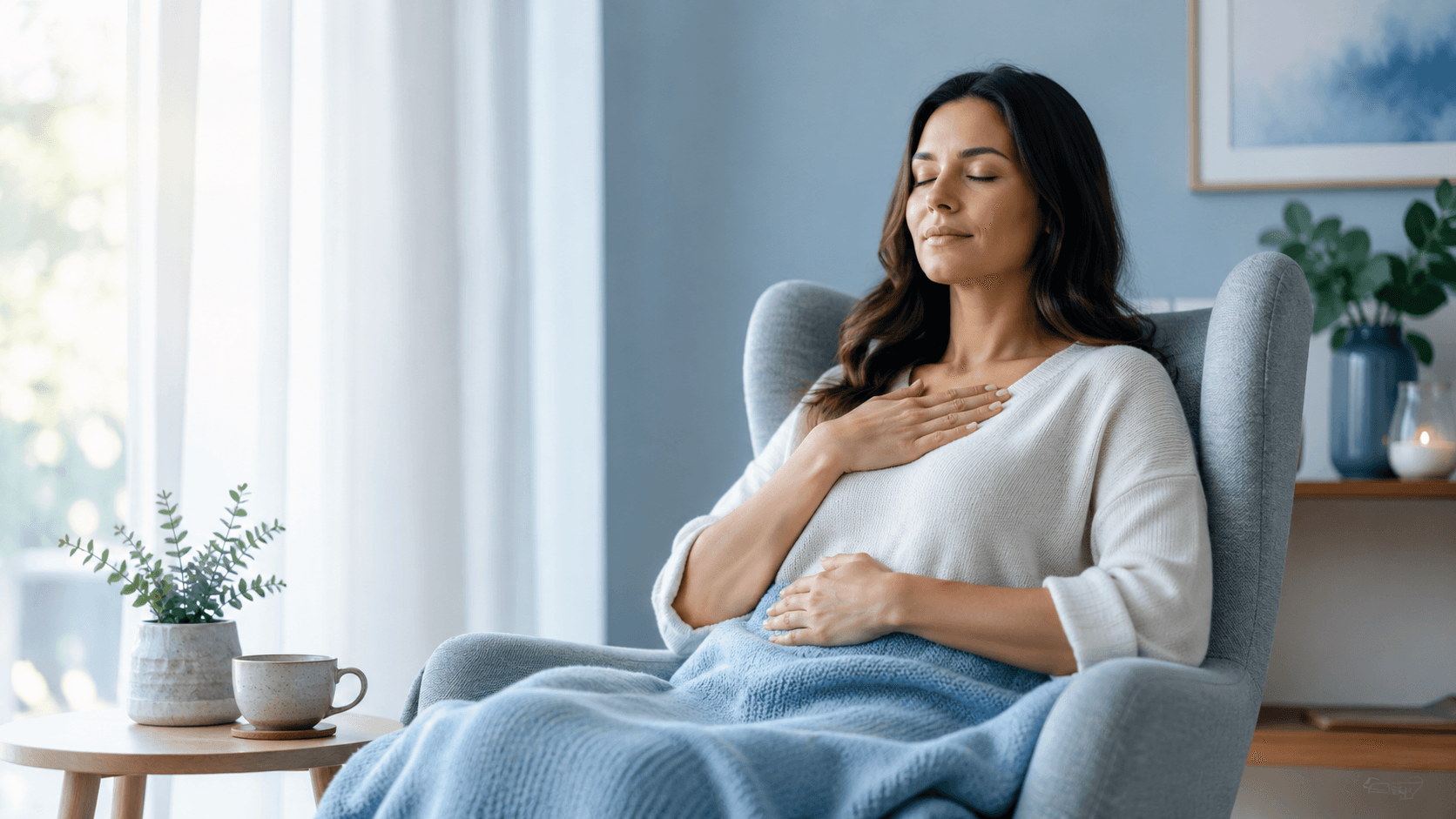
Find a comfortable place to sit or rest.
Let your body be supported.
You do not have to force a certain posture. Just allow yourself to settle in a way that feels safe and comfortable.
Take a moment to notice the room around you.
Notice that, in this moment, you are here.
You are breathing.
You are supported.
Step 2: Set a Simple Intention
Choose one simple intention for the practice.
It may be:
“I want to feel calmer.”
“I want to release tension.”
“I want to quiet my thoughts.”
“I want to feel safe in my body.”
“I want to give myself a few minutes of peace.”
Keep it simple.
Your intention is not a demand. It is a direction.
Step 3: Slow Your Breathing
Begin by taking a slow breath in through your nose, if that feels comfortable.
Then exhale slowly.
Try breathing in for a count of 4.
Then exhale for a count of 6.
Inhale gently.
Exhale slowly.
You do not have to strain or force the breath.
Just let each exhale be a little longer than the inhale.
You might silently say to yourself:
“Breathing in, I arrive.”
“Breathing out, I soften.”
Do this for several rounds.
With each exhale, imagine your body receiving the message:
“You can begin to let go now.”
Step 4: Relax the Body
Now bring your attention to your forehead.
Let the forehead smooth.
Bring your attention to your eyes.
Let the muscles around the eyes soften.
Bring your attention to your jaw.
Let the jaw unclench.
Bring your attention to your shoulders.
Let them drop, even slightly.
Bring your attention to your chest.
Let the breath move gently through this space.
Bring your attention to your stomach.
Let it soften as much as it is willing to soften.
Bring your attention to your hands.
Let the fingers loosen.
Bring your attention to your legs and feet.
Let them feel supported beneath you.
You do not have to make your body relax all at once.
Just invite each area to soften.
Little by little.
Breath by breath.
Step 5: Imagine a Calm Place
Now imagine a place where you can feel peaceful.
It may be a beach, a garden, a forest, a quiet room, a cozy chair, or any place that feels safe and calming to you.
It does not have to be a real place.
It only has to feel good to your mind and body.
Notice what you see there.
Notice the colors.
Notice the light.
Notice the temperature of the air.
Notice any sounds.
Notice what it feels like to be in this place.
Let your body respond as if you are already there.
As if this calm place is not something you have to reach.
It is something you can remember.
Step 6: Repeat a Calming Suggestion
Choose one calming suggestion and repeat it slowly in your mind.
You might use:
“I am safe enough in this moment.”
“My body can soften now.”
“I can take this one breath at a time.”
“I do not have to solve everything right now.”
“My mind can slow down.”
“My nervous system can return to calm.”
“I can feel grounded in my body.”
Repeat your chosen phrase several times.
Do not rush it.
Let the words land.
Imagine the suggestion moving through your mind, your breath, and your body.
If your mind wanders, that is okay.
Just gently return to the phrase.
There is no need to criticize yourself.
Returning is part of the practice.
Step 7: Return Slowly
When you feel ready, begin to bring your awareness back to the room.
Notice the surface beneath you.
Notice the sounds around you.
Notice your breath.
You can count from 1 to 5.
1, becoming aware of your body.
2, bringing energy back into your hands and feet.
3, taking a deeper breath.
4, noticing the room around you.
5, returning fully, feeling grounded and present.
Take your time before standing.
Let yourself notice how you feel.
You may feel deeply relaxed. You may feel only a little calmer. You may simply feel more aware of your body than before.
Whatever you notice is okay.
If you would rather listen instead of guiding yourself, I created a free hypnosis audio for stress and anxiety. You do not have to know how to do hypnosis. You can simply listen, follow along, and allow your body to begin practicing calm.
Get the free self-hypnosis audio for stress and anxiety.
How Often Should You Practice Self-Hypnosis?
If you are new to self-hypnosis, start small.
Five to ten minutes is enough.
You do not have to do a long practice for it to be helpful. In fact, shorter practices are often easier to repeat, and repetition is what teaches the mind and body a new pattern.
You may want to practice:
- In the morning before the day begins
- During a lunch break
- Before an anxiety-provoking event
- After work to decompress
- Before bed
- Anytime you notice your body becoming tense or overwhelmed
Consistency matters more than perfection.
A few minutes every day can be more helpful than one long session once in a while.
The goal is not to never feel stress.
The goal is to help your body learn that stress does not have to take over completely.
Best Self-Hypnosis Suggestions for Stress and Anxiety
The words you use in self-hypnosis matter.
You want suggestions that feel calming, supportive, and believable.
If a statement feels too far away, soften it.
Instead of saying:
“I am completely calm.”
You might say:
“I am learning to feel calmer.”
Instead of saying:
“I never feel anxious.”
You might say:
“I can support myself when anxiety shows up.”
Here are some suggestions you can use.
For Racing Thoughts
“I do not have to solve everything right now.”
“One breath is enough for this moment.”
“My mind can slow down.”
“I can let this thought pass without following it.”
“I can return to the present moment.”
“I am allowed to pause.”
For Physical Tension
“My jaw can release.”
“My shoulders can soften.”
“My stomach can loosen.”
“My body knows how to relax.”
“I can let the tension begin to melt.”
“I am supported in this moment.”
For Anxiety
“I am safe enough right now.”
“This feeling can move through me.”
“I can respond instead of react.”
“I do not have to fear this feeling.”
“My body is learning a new way.”
“I can meet myself with compassion.”
For Stress
“I can take this one step at a time.”
“I do not have to carry everything at once.”
“I can release what is not mine to hold.”
“I can come back to myself.”
“I am allowed to rest.”
“I can handle this moment.”
For Sleep
“There is nothing I need to figure out tonight.”
“Rest is safe.”
“My body can let the day go.”
“My mind can become quiet.”
“I can drift into rest one breath at a time.”
“Sleep can come naturally.”
What If Self-Hypnosis Does Not Work Right Away?
This is very common.
Some people expect self-hypnosis to feel dramatic. They expect their mind to go completely blank or their body to become instantly calm.
But hypnosis is not always dramatic.
Sometimes the shift is subtle.
You may notice your breathing slows a little.
Your shoulders soften slightly.
Your thoughts feel less sharp.
Your body feels a little heavier.
You feel more present.
You feel less alone inside the experience.
That counts.
It is also normal for the mind to wander. That does not mean you are doing it wrong. The mind wanders because that is what minds do.
Each time you gently bring yourself back, you are strengthening the practice.
Self-hypnosis is not about controlling every thought.
It is about creating a calmer inner direction.
When Self-Hypnosis May Not Be Enough
Self-hypnosis can be a helpful tool for stress and anxiety, but it is not always enough on its own.
Please consider additional support if:
- Anxiety is interfering with your daily life
- You are having frequent panic attacks
- You feel unable to function normally
- You are avoiding important parts of your life because of anxiety
- Your symptoms are new, intense, or worsening
- You have trauma symptoms that feel overwhelming
- You feel unsafe with yourself
- You are having thoughts of self-harm
Hypnosis and self-hypnosis are complementary supports. They are not a substitute for medical care, mental health care, diagnosis, crisis support, or treatment from a licensed healthcare provider.
If you are in crisis or feel like you may harm yourself, please seek immediate help by calling emergency services or contacting a crisis hotline in your area.
Self-hypnosis can be a beautiful support, but you do not have to rely on it alone.
When to Work With a Hypnotist for Stress and Anxiety
Self-hypnosis is a wonderful place to start.
It gives you a tool you can use on your own. It helps you practice calm. It allows you to build trust with your own mind and body.
But sometimes, stress and anxiety are connected to deeper patterns.
You may notice that you understand your anxiety, but it still does not shift.
You may feel calm for a little while, then return to the same cycle.
You may know what you “should” do, but part of you keeps reacting the same way.
That is where guided hypnosis can help.
In a private hypnosis session, you are not left trying to figure it all out on your own. The process is guided and personalized. We can work with the subconscious patterns, emotional responses, inner beliefs, and protective parts that may be contributing to the stress or anxiety.
Sometimes the question is not only:
“How do I calm down?”
Sometimes the deeper question is:
“What part of me does not feel safe yet?”
Or:
“What is my body trying to protect me from?”
Or:
“What pattern am I ready to release?”
Guided hypnosis creates space to explore those questions gently.
Not by forcing answers.
Not by analyzing everything to death.
But by allowing the subconscious mind to communicate in the way it knows how, through feelings, images, memories, sensations, emotions, and inner knowing.
Why Work With Intuitive Clarity Hypnosis?
I am Marcelina Hardy, a Certified Hypnotist and founder of Intuitive Clarity Hypnosis.
My work focuses on helping people understand and shift the subconscious patterns that keep them feeling stuck, anxious, overwhelmed, or disconnected from themselves.
I hold a BA in Psychology and an MSEd in Counseling, and I have completed hypnosis training through respected organizations, including ASCH Level 1 and 2 training. I am also trained in regression work through the Edgar Cayce A.R.E.
My background includes work in recovery coaching, case management, counseling-related support, mental health, and substance abuse settings.
In my hypnosis practice, I bring together education, subconscious work, nervous system awareness, and a grounded, supportive approach to help clients explore what is happening beneath the surface.
Sessions are available in person in Virginia Beach and online by Zoom for clients in Norfolk, Hampton Roads, and beyond.
My goal is not to make you feel like something is wrong with you.
My goal is to help you understand what your mind and body may be trying to communicate, so you can begin moving forward with more clarity, calm, and confidence.
Can Self-Hypnosis Help You Feel Calm Permanently?
Self-hypnosis can help you build a calmer response over time, but it is not about becoming a person who never feels stress or anxiety.
Stress is part of being human.
Anxiety is often a protective response.
The goal is not to erase your emotions.
The goal is to help your body stop living as if every stressful thought is an emergency.
With practice, self-hypnosis may help you:
- Notice anxiety sooner
- Calm your breathing faster
- Relax your body more easily
- Interrupt spiraling thoughts
- Feel more grounded
- Respond with more choice
- Sleep more peacefully
- Build trust in your ability to support yourself
That is real progress.
Not because you never feel anxious.
But because anxiety no longer has to be the only voice in the room.
Tips for Getting the Most Out of Self-Hypnosis
Keep It Simple
You do not need a perfect script, a perfect voice, or a perfect environment.
A quiet place, a few calming words, and a willingness to practice are enough.
Use the Same Suggestion Repeatedly
The subconscious mind learns through repetition.
Choose one or two calming suggestions and use them consistently.
Practice When You Are Already Somewhat Calm
It can be harder to learn self-hypnosis for the first time when you are already in high anxiety.
Practice during calmer moments so the process becomes familiar. Then it may be easier to use when stress rises.
Do Not Judge Your Experience
Some sessions will feel deep.
Some will feel light.
Some will feel peaceful.
Some will feel like your mind wandered the whole time.
That is okay.
You are still practicing.
Let the Body Lead
You do not have to force an emotional breakthrough.
Sometimes the most powerful thing you can do is help your body feel safe enough to soften.
Self-Hypnosis for Stress and Anxiety: A Simple Daily Practice
Here is a short practice you can use daily:
Take a slow breath in.
Exhale gently.
Let your shoulders soften.
Bring your attention to your body.
Silently say:
“I am here.”
“I am breathing.”
“I am safe enough in this moment.”
“My body can soften.”
“I can take this one breath at a time.”
Imagine a wave of calm moving from the top of your head down through your body.
Let it soften your forehead.
Your jaw.
Your shoulders.
Your chest.
Your stomach.
Your hands.
Your legs.
Your feet.
Then repeat:
“I do not have to solve everything right now.”
“I can return to myself.”
“My nervous system can learn calm.”
Take one more slow breath.
Then gently return to the room.
That may only take two or three minutes.
And sometimes, two or three minutes is enough to interrupt the pattern and remind your body that there is another way.
Final Thoughts: You Can Begin Gently
If you have been dealing with stress and anxiety, you may feel like you should be able to control it by now.
But anxiety is not a character flaw.
Stress is not a weakness.
And needing support does not mean you are failing.
It means your mind and body have been carrying something, responding to something, or protecting you in a way that may no longer be helping.
Self-hypnosis gives you a gentle way to begin creating a new relationship with your nervous system.
You do not have to force yourself into calm.
You can invite calm.
You can practice calm.
You can teach your body, little by little, that it is safe to soften.
And if you need support beyond self-hypnosis, that is okay too.
Sometimes the most healing thing you can do is stop trying to figure it all out alone.
I created a free hypnosis audio to help you relax, reset, and begin experiencing what hypnosis feels like. It is a gentle first step if stress and anxiety have been keeping your body on alert.
Download the free hypnosis audio here.
And if you feel ready for deeper support, you can also schedule a free consultation to talk about whether hypnosis and coaching may be a good fit for you.
Frequently Asked Questions About Self Hypnosis for Stress and Anxiety
Can self-hypnosis help with stress and anxiety?
Yes, self-hypnosis may help many people calm the body, quiet racing thoughts, and practice a more relaxed response to stress and anxiety. It works best when practiced consistently and should be used as a complementary support, not a replacement for medical or mental health care.
Is self-hypnosis safe?
Self-hypnosis is generally safe for many people when used for relaxation, stress relief, and personal development. However, if you have severe anxiety, trauma symptoms, panic attacks, or mental health concerns, it is best to work with a qualified professional and consult a licensed healthcare provider when needed.
How long should I do self-hypnosis?
You can start with 5 to 10 minutes. Once you feel comfortable, you may practice for 15 to 20 minutes. A short daily practice is often more helpful than waiting until you have time for a longer session.
What should I say during self-hypnosis?
Use simple, calming suggestions such as “I am safe enough in this moment,” “My body can relax,” “I can take this one breath at a time,” or “My nervous system can learn calm.”
Is self-hypnosis the same as meditation?
No. Meditation usually focuses on awareness, observation, or presence. Self-hypnosis uses a relaxed, focused state to work toward a specific goal, such as calming anxiety, releasing tension, improving sleep, or building confidence.
Can self-hypnosis stop anxiety completely?
Self-hypnosis may help reduce anxiety, but it is not a guaranteed cure. Anxiety can have many causes, and some people benefit from therapy, medical care, coaching, hypnosis, or a combination of support.
When should I work with a hypnotist?
You may want to work with a hypnotist if stress or anxiety feels persistent, difficult to manage on your own, or connected to deeper subconscious patterns. Guided hypnosis can be personalized to your specific experiences and goals.
Can I use self-hypnosis before bed?
Yes, many people use self-hypnosis before bed because it helps relax the body and gives the mind something calming to focus on. If you use self-hypnosis for sleep, choose suggestions that support rest, safety, and letting go of the day.
