
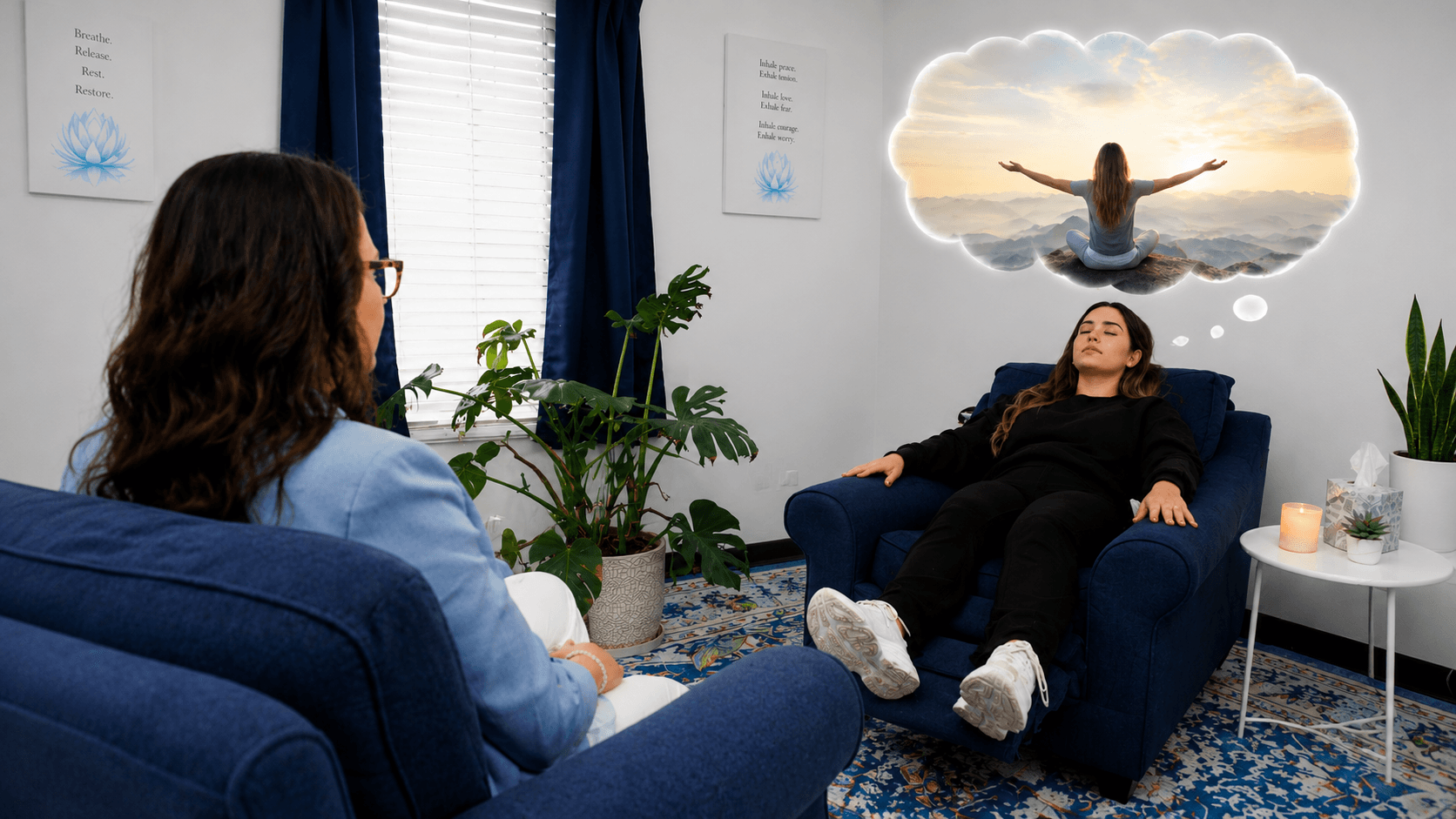
Quick answer: Stress relief hypnosis is a guided, focused state of relaxation that helps your subconscious mind release stress patterns, calm the nervous system, and create a sense of inner safety. It works with the deeper part of the mind where stress responses are stored, supporting natural calm rather than forcing it.
When Stress Will Not Let Go
It is 2 a.m. again. Your shoulders are pulled up toward your ears. Your mind is replaying a conversation from earlier in the day, or rehearsing one that has not happened yet. The house is quiet, your life on paper looks fine, and still — your body will not settle.
If that scene feels familiar, you are not broken, and you are not alone. Stress is rarely “just stress.” It lives in tight muscles, in shallow breathing, in the way your jaw clenches before your mind even registers what it is reacting to. It lives in the subconscious, where old patterns quietly run the show long after the original stressor has passed.
This is a guide to how stress relief hypnosis works, what a session actually feels like, and how this kind of inner work can help your body and mind remember what calm feels like. Sessions are offered in person in Virginia Beach, throughout the Hampton Roads area, and online to clients worldwide.
What Is Stress Relief Hypnosis?
Stress relief hypnosis is a natural, guided process that uses focused relaxation to help your conscious mind soften and your subconscious mind become more open to calm, supportive suggestions. It is not sleep. It is not mind control. It is not losing awareness. You stay aware, in control, and able to come out of the state at any time.
Think of it as a deeply relaxed but highly focused state — similar to the moment right before you fall asleep, or the way you can drive a familiar route on autopilot while your conscious mind drifts. In that state, the mind becomes more receptive to gentle, intentional change.
How It Differs From Meditation, Sleep, or “Just Relaxing”
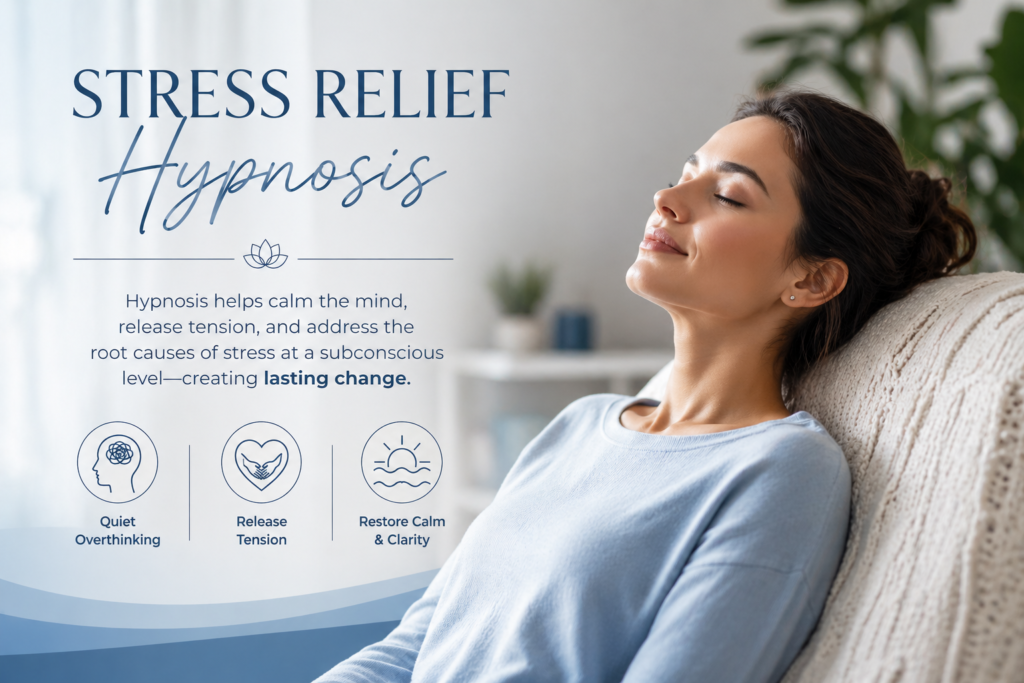
Meditation invites stillness and observation. Hypnosis goes a step further and works directly with the subconscious patterns that drive stress reactions. Sleep disconnects awareness; hypnosis stays focused, conscious, and purposeful. And while a long bath or a good walk can help you relax, that relief often fades the moment life turns the heat back up. Hypnosis is goal-directed and personalized. It is not just a pause from stress, it is a process for changing how you respond to it.
A Soul-Centered Take on Stress
Stress is not only mental and physical. Often, it is a quiet signal of disconnection from your inner self, from your body, from what genuinely matters to you. The work offered here blends grounded, clinical hypnosis with a spiritual hypnosis lens that honors the whole person: mind, heart, and soul. You are welcome to take only the practical layer if that fits you, or to explore the deeper one if you feel drawn to it.
Why Stress Stays Stuck in the Body and Mind
The Fight-or-Flight Response, Simply
When your brain perceives a threat, the autonomic nervous system kicks into the fight-or-flight response: heart rate climbs, breathing quickens, muscles tense, and stress hormones flood the system. That response is brilliant in a real emergency. The problem is that for many people, it never fully turns off. The American Psychological Association recognizes chronic stress as a meaningful contributor to both physical and mental health concerns — it can affect sleep, digestion, mood, immunity, and long-term well-being.
Why Willpower Alone Is Not Enough
Most people try to think their way out of stress. They make lists, set rules, and tell themselves to calm down. But the conscious mind makes up only about 5 to 10 percent of mental activity. The subconscious holds the rest — including stress responses, emotional habits, and protective beliefs formed long before you had words for them.
Telling yourself to relax often makes things worse, because the message is being sent to the wrong layer of the mind. “Trying harder” can actually crank up the tension. This is one of the reasons stress feels so hard to outrun.
Subconscious Stress Patterns
Old emotional memories, learned coping strategies, and protective beliefs run quietly in the background of daily life. A tone of voice that mirrors something from childhood, a deadline that recalls an earlier overwhelm, a relationship dynamic that taps an old wound — and the body braces, even when nothing is wrong in the present moment.
These patterns are not a flaw. They were once intelligent responses to real situations. They simply need to be updated. This is the territory where hypnosis for emotional and behavioral support does its deepest work — gently revising the subconscious blueprint, not just the surface symptom.
How Stress Relief Hypnosis Works
Calming the Nervous System
During a session, your breath naturally slows, your heart rate eases, and your body shifts out of the sympathetic (alert) branch of the nervous system into the parasympathetic (rest and restore) branch. Over time, this gives the body something it has been missing: a clear, repeatable memory of what safety actually feels like.
Quieting Racing Thoughts
Hypnosis does not force the mind to stop. It lowers the volume on mental chatter and creates a small, life-changing space between a stressful trigger and your automatic reaction. In that space, you have a choice. With practice, that pause becomes available to you in everyday life, not just on the recliner.
Shifting Subconscious Stress Patterns
Through targeted suggestion, imagery, and gentle pattern work, hypnosis updates the inner messages that fire under pressure. “I cannot handle this” softens into “I can take this one breath at a time.” “I have to do everything perfectly” becomes “I am allowed to be human.” These small inner edits, repeated consistently, build emotional regulation and resilience that hold up in the real world.
Reconnecting With Your Higher Self
A subtle but powerful layer of this work: stress often eases when you feel held by something larger than the immediate moment. For clients who are open to it, sessions can include gentle Higher Self guidance — a quiet conversation with the wisest, calmest, most loving part of you. It is never imposed. It is offered, the way a soft blanket is offered.
The Benefits of Stress Relief Hypnosis
People come to this work for many reasons. The benefits most clients describe include:
- Deeper, more lasting relaxation
- Reduced overthinking and mental fatigue
- Calmer nervous system responses
- Better sleep and an easier wind-down at night
- Stronger emotional regulation under pressure
- A greater sense of inner safety
- Reduced muscle tension and physical stress symptoms
- More clarity around what is actually causing the stress
- Self-hypnosis tools you can use on your own between sessions
Short-Term vs. Long-Term Benefits
After a single session, most clients walk out feeling lighter, clearer, and more grounded. After several sessions, the changes deepen: stress responses get rewired, the baseline level of calm rises, and reactive moments become less frequent and less intense. Stress stops running the show.
What a Stress Relief Hypnosis Session Looks Like
Step 1 — Conversation and Intake
We begin with a real conversation. What does stress feel like in your body? Where do you carry it? What triggers it? What would calm actually look like in your life? This is also where you can ask any questions about hypnosis, the process, or what to expect.
Step 2 — Guided Relaxation
Next comes a gentle induction using breath, imagery, and focused attention. Your body settles into the chair. Your shoulders drop. Your mind softens. There is nothing to perform here — your only job is to listen and let go.
Step 3 — Subconscious Work
Once you are comfortably relaxed, we move into the heart of the session: targeted suggestions, visualization, and pattern shifting tailored to what you shared in the intake. For clients drawn to a more soul-centered experience, this is where Higher Self guidance can be woven in.
Step 4 — Coming Back and Integration
You return to full awareness gently, on your own pace. We talk about what came up, what felt meaningful, and what you noticed. You leave with simple suggestions for self-hypnosis or supportive practices to use between sessions, so the inner shift continues to settle in.
How Long Is a Session?
Sessions typically run 120 minutes. The first session is usually a little longer to allow for a full intake and a relaxed, unhurried beginning.
Who Stress Relief Hypnosis Is For (and Who It Is Not For)
This Work May Be a Good Fit If You
- Feel stuck in chronic stress, overwhelm, or burnout
- Wake up tense or anxious for no clear reason
- Carry tension that talk therapy alone has not eased
- Want a natural, non-medication approach to stress
- Are open to gentle inner exploration
This Work May Not Be the Best Fit If You
- Are in active crisis or experiencing thoughts of self-harm
- Need acute mental health intervention
- Are seeking a medical diagnosis or treatment
If any of those apply, please reach out to a licensed mental health professional or call or text the 988 Suicide and Crisis Lifeline. Hypnosis is a complementary support, not a replacement for licensed care. You can read more in the full disclaimer.
How Stress Relief Hypnosis Compares to Other Approaches
Hypnosis vs. Talk Therapy
Talk therapy works primarily with the conscious mind through dialogue, insight, and reflection. Hypnosis works directly with the subconscious, where stress patterns actually live and replay. The two are not in competition. Many clients find that combining them creates faster, deeper progress than either alone.
Hypnosis vs. Meditation Apps
Meditation apps offer general relaxation and are wonderful as a daily practice. Hypnosis sessions are personalized, interactive, and goal-specific — designed to address the root pattern fueling your stress, not only the surface symptom.
Hypnosis vs. Medication
For some people, medication is a vital and necessary tool. Hypnosis can complement that path, offering a drug-free way to support nervous system regulation alongside whatever your medical team has recommended. It is never an either/or — and your prescribing provider should always stay in the loop.
Stress, Anxiety, and the Subconscious — Where They Overlap
Many people who search for stress relief are quietly dealing with anxiety as well, especially the kind that lives in the body — the racing heart, the tight chest, the sense of dread without an obvious cause.
Over time, unprocessed stress can become a looping anxiety pattern. The nervous system gets so used to running hot that it forgets how to come down. If that resonates, you may also benefit from dedicated hypnosis for anxiety work, which goes deeper into those persistent fear and worry loops.
Self-Hypnosis Techniques You Can Use Today
These short practices will not replace a guided session, but they are real tools you can carry into a stressful afternoon.
Three-Minute Breath Anchor
Try 4-7-8 breathing: inhale through the nose for a count of 4, hold for 7, exhale slowly through the mouth for 8. Repeat four cycles. The long exhale is the key — it tells the nervous system that the threat is over.
Body Scan for Tension Release
Close your eyes. Bring attention to your feet. Notice any tension and let it soften. Slowly move your attention up through the calves, knees, hips, belly, chest, shoulders, jaw, and forehead. Spend a breath or two at each stop. This single practice often reveals how much stress you have been carrying without realizing it.
A Simple Calm Place Visualization
Picture a place — real or imagined — where you feel completely safe. A cabin, a beach, a garden, a grandmother’s kitchen. Engage all five senses: what you see, hear, smell, feel, even taste. Let your body soak it in for a few minutes. With practice, you can return there on command, even in a tense meeting.
When Self-Hypnosis Is Not Enough
Self-practice helps with the surface layer. Deeper subconscious patterns, especially those rooted in old experiences or long-term stress, often need guided support. If you would like a starting point, gentle self-hypnosis audios are available on the site to use between sessions.
Stress Relief Hypnosis in Virginia Beach
In-person sessions are held at:
5250 Challedon Drive, Suite 100L Virginia Beach, VA 23462
The office is easily accessible from Norfolk, Chesapeake, Hampton, Newport News, Suffolk, and Portsmouth — and is designed as a calm, inviting setting where deep relaxation feels natural. You can learn more about the in-person experience on the Hypnosis in Virginia Beach page.
Serving the Hampton Roads Community
Hampton Roads carries its own particular kind of stress. Military families navigate deployments, transitions, and the invisible weight of service. Healthcare workers and first responders run on adrenaline that does not always have somewhere to land. Busy professionals, parents, and caregivers often arrive depleted in ways they have not had time to name. Local clients are met with care that respects those realities — no rushing, no judgment, just a steady, supportive space.
Online Stress Relief Hypnosis Sessions
Online sessions are available worldwide via Zoom. All you need is a quiet room, a pair of headphones, and a stable internet connection. Many clients say online sessions feel even more relaxing than in-person, because they are already in their own space — their own couch, their own blanket, their own lighting. If you want support with goals beyond stress relief, an online hypnotherapist can tailor hypnosis to a wider range of personal goals and patterns.
The depth, personalization, and care are exactly the same.
How to Prepare for an Online Session
A short checklist for the smoothest experience:
- Choose a quiet space where you will not be interrupted
- Have water nearby
- Sit or recline somewhere comfortable enough to fully relax for 60 to 90 minutes
- Use headphones for richer audio
- Silence notifications on your phone and computer
- Let anyone in your home know you will be unavailable for the session window
How Many Sessions Will You Need?
Most clients feel meaningful relief within the first one to three sessions. Deeper, lasting change often unfolds across three to six sessions, depending on how long the stress pattern has been in place and what is underneath it.
Factors That Influence the Number of Sessions
A few things shape the timeline:
- How long stress has been chronic in your life
- Whether trauma, grief, or significant loss is part of the picture
- How open and consistent you are with practice between sessions
- Whether other supportive practices (therapy, sleep, movement) are in place
There is no race here. The right pace is the one that honors what you actually need.
The Science Behind Stress Relief Hypnosis
Hypnosis is not a fringe practice. It is supported by decades of clinical research. Studies indexed on PubMed show that hypnosis can lower cortisol levels, support nervous system regulation, and meaningfully reduce subjective stress. The Mayo Clinic recognizes hypnosis as a legitimate clinical tool used alongside other treatments for pain, anxiety, sleep concerns, and stress-related conditions. The American Psychological Association likewise recognizes hypnosis as a legitimate therapeutic technique when offered by trained practitioners.
The deeper reason this work creates lasting change is neuroplasticity — the brain’s ability to form new pathways throughout life. Each time you rehearse a calmer response under hypnosis, you are quite literally building a new neural route. Over time, that route becomes the default.
Why Choose Intuitive Clarity Hypnosis
Meet Marcelina Hardy
Marcelina holds a BA in Psychology and an MSEd in Counseling, and is currently completing a PhD in Metaphysical Psychology. My professional background includes recovery coaching, case management, and work in mental health and substance abuse counseling — so I bring real clinical training and a wide field of lived experience to every session, alongside the soul-centered insight that defines this practice. You can read my full story on the About Marcelina page.
Credentials and Affiliations
- Member of the National Guild of Hypnotists
- Levels 1 and 2 Clinical Hypnosis training through the American Society of Clinical Hypnosis
- Certified Past Life Regressionist through the Edgar Cayce A.R.E.
- BBB Accredited Business
A Different Kind of Hypnosis Experience
Sessions are personalized, never one-size-fits-all. The atmosphere is grounded, professional, and emotionally safe and the work blends traditional, evidence-informed hypnosis with optional spiritual and Higher Self elements for clients who want them. Nothing is forced. Everything is offered.
What Clients Are Saying
Clients consistently describe feeling deeply heard, surprisingly relaxed, and quietly changed by the experience (often in ways that ripple out into sleep, relationships, and daily mood in the weeks that follow). You can read more on the Success Stories page.
What to Look For in a Stress Relief Hypnotist
If you are considering hypnosis with anyone — here or elsewhere — these are reasonable things to look for:
- Certification through reputable organizations (NGH, ASCH, or equivalent)
- Clinical training and ongoing continuing education
- A calm, non-pushy approach during the inquiry call
- Clear ethics and a willingness to refer out when something is outside their scope
- Personalized intake rather than generic, scripted sessions
- Transparency about what hypnosis is and is not
Frequently Asked Questions About Stress Relief Hypnosis
Does stress relief hypnosis really work?
Yes, for many people. Hypnosis helps the nervous system shift out of fight-or-flight, calms racing thoughts, and updates subconscious patterns that keep stress looping. Results vary by person, but most clients notice meaningful relief within the first few sessions.
Will I lose control during hypnosis?
No. You remain fully aware and in control the entire time. Hypnosis is a collaborative process — something you do with your hypnotist, not something done to you. You cannot be made to do or say anything against your values.
Can hypnosis cure my stress permanently?
Hypnosis is not a cure. It is a tool that helps you respond to stress differently. With consistent work, many clients experience long-term improvements in how they handle pressure, how quickly they recover from it, and how often they get pulled into it in the first place.
Is online stress relief hypnosis as effective as in-person?
Yes. Online sessions are deeply effective, and many clients actively prefer them because they can relax fully in their own home and skip the drive afterward.
How is stress relief hypnosis different from anxiety hypnosis?
Stress and anxiety overlap, but stress hypnosis often focuses on present-day pressure, overload, and overwhelm, while anxiety hypnosis addresses deeper, looping fear and worry patterns — including those that show up without any clear external trigger.
Is stress relief hypnosis safe?
Yes, when guided by a trained, certified hypnotist. Hypnosis is a natural state and not harmful. It is not, however, a replacement for licensed mental health or medical care, and it is not appropriate for active mental health crises.
How much does a stress relief hypnosis session cost?
Pricing varies by session type and length. Reach out via the contact page for current rates and availability.
Do you offer stress relief hypnosis near me in Norfolk or Hampton Roads?
Yes. Clients throughout Norfolk, Virginia Beach, Chesapeake, Hampton, Newport News, Suffolk, Portsmouth, and the broader Hampton Roads area are warmly welcomed in person at the Virginia Beach office. Online sessions are available anywhere.
What should I do before my first session?
Get a good night’s sleep, hydrate, eat a light meal, avoid alcohol, and arrive with an open mind. More tips and answers are available on the Hypnosis FAQs page.
Can I combine hypnosis with therapy or medication?
Yes. Hypnosis is often a wonderful complement to therapy and medical care. Always keep your licensed providers informed about any complementary work you are doing, especially if your treatment plan changes.
Ready to Feel Calm Again?
Reaching out can feel like a lot when you are already stretched thin. Please know this is a safe, supportive, no-pressure space. There is no script you need to follow, no perfect way to start, and no level of stress that is “too much” or “not enough” to ask for help.
If you are ready, two simple next steps:
- Book a stress relief hypnosis session — choose a time that works for you.
- Get clarity on what’s causing your stress — reach out via the contact page with any questions before booking.
Or simply call: 757-804-1006
In-person sessions are available in Virginia Beach. Online sessions are available worldwide.
A Quieter Mind Is Possible
Stress is real. It is not, however, who you are. Underneath the tight shoulders and the racing thoughts, there is a steadier, wiser part of you that has been there all along — sometimes faintly, sometimes loudly, always there.
Healing begins when you quiet the mind and listen to the wisdom within.
When you are ready, schedule your session. The first quiet breath is closer than it feels.
This article is for educational purposes and is not medical advice. Please see the full disclaimer for more information.
