
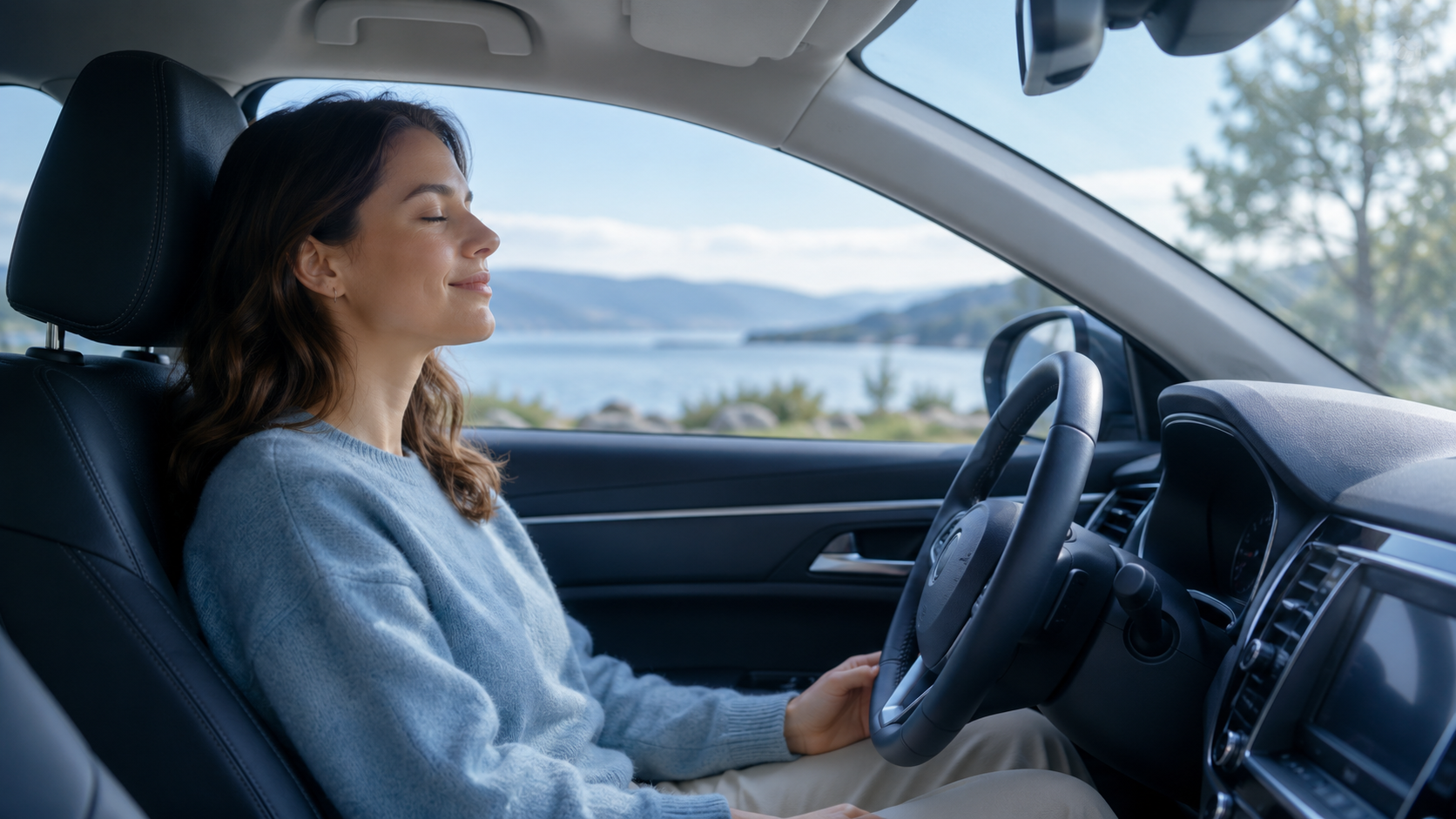
Calm Your Nervous System and Feel Safer Behind the Wheel
Driving anxiety can feel confusing because part of you knows how to drive, or wants to drive, but another part of you reacts as if the road is dangerous. Your body may tense up, your thoughts may race, and your nervous system may go into fight-or-flight before you even start the car.
Hypnosis for driving anxiety helps work with the subconscious patterns behind that fear response so your mind and body can begin associating driving with calm, safety, and control again.
Quick Answer: Can Hypnosis Help Driving Anxiety?
Hypnosis may help driving anxiety by calming the nervous system, working with subconscious fear patterns, and helping the mind rehearse a safer, steadier response to driving. It is not mind control, and you remain aware and in control throughout the session.
What Is Driving Anxiety?
Driving Anxiety Is More Than Being Nervous Behind the Wheel
Driving anxiety is a fear response connected to driving, riding in a car, or specific driving situations. It may show up as mild nervousness, avoidance, panic, or intense fear of losing control. It can affect your independence and daily life even when you know the fear is not fully rational.
Common Driving Anxiety Triggers
- Highways and interstates
- Bridges and tunnels
- Heavy traffic
- Merging lanes
- Left turns
- Unfamiliar roads
- Driving alone
- Driving at night
- Being a passenger
- Driving after an accident
- Fear of panic while driving
- Fear of being trapped in traffic
Driving Anxiety, Amaxophobia, Vehophobia, and Fear of Driving
People search for this experience by many names: fear of driving, driving phobia, amaxophobia, vehophobia, highway driving anxiety, or panic attacks while driving. Whatever you call it, the experience is real, and the subconscious patterns behind it can be worked with through hypnotherapy for emotional and behavioral concerns.
What Driving Anxiety Can Feel Like
Physical Symptoms
- Racing heart
- Tight chest
- Sweating
- Shaking or trembling
- Nausea
- Dizziness
- Muscle tension
- Shallow breathing
Emotional and Mental Symptoms
- “What if I panic and can’t think clearly?”
- “What if I lose control of the car?”
- “What if I can’t get off the highway?”
- “What if other drivers get angry at me?”
- “What if something goes wrong and I’m alone?”
Underneath these thoughts is often a felt sense of being trapped, unsafe, embarrassed, or out of control, even when the actual road situation is manageable.
Avoidance Patterns
Avoidance offers immediate relief. Taking back roads, asking for rides, or simply not going somewhere can feel like the only way to cope in the moment. The difficulty is that avoidance reinforces itself. Each time you sidestep a driving situation, the subconscious registers that avoidance kept you safe. Over time, the world can begin to feel smaller, and the anxiety can feel larger.
Why Driving Anxiety Happens
Your Nervous System Is Trying to Protect You
The American Psychological Association describes anxiety as involving tension, worried thoughts, and physical changes in the body. Driving anxiety fits that pattern precisely. The body may react as if there is immediate danger, with elevated heart rate, shallow breathing, and muscle tension, even when the actual situation is manageable.
This is not a character flaw. It is the nervous system doing what it was designed to do. The challenge is that it has learned to activate in situations where protection is not actually needed.
The Subconscious Mind Learns Through Association
If your mind connected driving with danger, panic, embarrassment, loss of control, or a past stressful experience, the subconscious may continue triggering that response long after the original situation has passed. This is not a conscious choice. It is an automatic pattern. Because it lives beneath conscious awareness, conscious reassurance often does not fully reach it.
Sometimes There Is No Obvious Cause
Some people develop driving anxiety after a car accident. Others develop it after a panic attack behind the wheel, a stressful period in life, a difficult driving lesson, or no single identifiable event at all. You do not need to pinpoint a cause to do meaningful work.
How Hypnosis for Driving Anxiety Works
Hypnosis Helps Calm the Fight-or-Flight Response
When driving triggers the body’s alarm system, the goal of hypnosis is not to convince the mind that everything is fine. It is to help the body actually feel safer. Through relaxation, focused attention, and nervous system regulation, hypnosis can calm that automatic alarm response and create a felt sense of safety that logic alone often cannot produce.
Hypnosis Works With the Subconscious Mind
Driving anxiety is often connected to subconscious patterns that were created to keep you safe, even when those patterns now limit your independence. Hypnosis works gently with those patterns, acknowledging what the nervous system learned and helping it learn something new. This is part of the broader emotional and behavioral hypnosis work offered at Intuitive Clarity Hypnosis.
Hypnosis Can Help Repattern the Driving Response
During hypnosis, the mind can begin practicing new associations and new internal experiences connected to driving:
- I can feel calm and present in the car.
- I can breathe and respond steadily to what is in front of me.
- I can drive one step at a time, at my own pace.
- I can feel more settled on familiar roads.
- I can respond calmly to normal traffic situations.
These are not affirmations to repeat consciously. They are internal experiences the subconscious begins to rehearse, which can shift how the body responds in real driving situations.
Hypnosis Is Not Mind Control
The American Society of Clinical Hypnosis states that hypnosis is not something imposed on people, and that the hypnotist serves as a guide or facilitator. You remain aware of what is happening throughout the session, and most people remember the experience afterward. For more on what hypnosis actually involves, visit the Hypnosis FAQs page.
What Makes Driving Anxiety Different From General Anxiety?
It Is Connected to a Specific Situation
Driving anxiety may be part of a broader anxiety pattern, but the fear often attaches to specific triggers: highways, bridges, traffic, speed, or distance from home.
It Can Affect Freedom and Independence
Driving anxiety is not just about the car. It can mean avoiding job opportunities that require driving, depending on others for rides, planning your entire life around back roads, feeling embarrassed or frustrated with yourself, and missing events, appointments, or connections you care about.
It Can Become a Loop
Fear leads to avoidance. Avoidance brings short-term relief. The subconscious then reinforces the belief that avoiding driving kept you safe. This can strengthen the anxiety over time, making the situations that feel manageable fewer and further between. Breaking this loop, gently and at the level of the subconscious, is one of the central goals of hypnotherapy for driving anxiety.
Hypnosis for Stress and Anxiety Behind the Wheel
Why Driving Anxiety Is Also a Stress Response
Driving anxiety is not only mental. It is often a full mind-body stress response involving the autonomic nervous system, subconscious stress patterns, and learned associations between driving and danger. That is why relaxation hypnosis, guided hypnosis for stress, and nervous system regulation are meaningful parts of this work.
Subconscious Stress Patterns and Driving
Many people with driving anxiety describe dread that begins before they ever get in the car. This is anticipatory anxiety, where the subconscious activates its protection response in advance. Subconscious stress patterns like this respond well to hypnotic approaches including relaxation hypnosis, guided imagery, nervous system regulation, and stress management techniques practiced in a calm, focused state.
Stress Relief Hypnosis in Virginia Beach for Driving Anxiety
If driving anxiety is affecting your daily life in Virginia Beach, hypnosis can offer a calm, personalized way to work with the stress response underneath the fear. In-person sessions in Virginia Beach provide a quiet, supportive space where you can explore what your subconscious has connected to driving and begin creating a new internal response.
Whether your anxiety is connected to the Interstate 64 corridor, the Hampton Roads Bridge-Tunnel, local traffic, or simply leaving familiar areas, sessions are tailored to the specific situations that feel most limiting for you.
Hypnosis for Driving Anxiety in Norfolk and Hampton Roads
Local Support for Drivers in Norfolk, Chesapeake, and Hampton Roads
For many drivers in Hampton Roads, driving anxiety shows up in specific, recognizable places: the Downtown Tunnel, the Midtown Tunnel, the Monitor-Merrimac Memorial Bridge-Tunnel, the Hampton Roads Bridge-Tunnel, or the stretch of I-64 connecting Virginia Beach and Norfolk.
For others, the anxiety is not about one location. It is about distance from home, heavy traffic, or the unpredictability of commuting routes. The goal of hypnosis for driving anxiety in this area is not to force confidence. It is to help your nervous system and subconscious mind begin feeling steadier, one step at a time.
In-person sessions are available for clients in Virginia Beach, Norfolk, Chesapeake, and the surrounding Tidewater area. Online hypnosis sessions are also available for clients who prefer not to commute.
Online Hypnosis for Driving Anxiety
Can Online Hypnosis Help Driving Anxiety?
Online hypnosis for driving anxiety can be a helpful option if leaving home, driving to an office, or navigating traffic feels overwhelming. Sessions are done from your own quiet, familiar space, which can help the body feel more relaxed and open to the work from the start.
Online sessions follow the same process as in-person sessions and clients consistently report that the virtual format does not diminish the depth of the experience. This makes online hypnosis for stress relief a practical starting point for many people whose anxiety makes getting to an office its own barrier.
What to Expect in a Hypnosis Session for Driving Anxiety
1. Conversation and Intention Setting
We begin by talking. When did the anxiety start? What situations trigger it? How does it feel in your body? What do you want to experience instead? This conversation shapes everything that follows.
2. Relaxation and Focused Attention
Hypnosis typically begins with relaxation, breathing, body awareness, or guided imagery. The Cleveland Clinic describes hypnosis as involving stages including induction, deepening, suggestions, and emergence, with most people remaining aware and in control throughout. For more on what to expect, visit the Hypnosis FAQs.
3. Subconscious Repatterning
We work gently with the part of the mind that learned driving was unsafe, acknowledging what it was trying to protect, and allowing it to update that response in a way that feels calm, steady, and supportive.
4. Future Rehearsal
You may be guided to imagine yourself navigating a driving situation with more calm, steadiness, and control. This gives the subconscious a new emotional template to practice, a felt experience of driving differently, before real-world practice begins.
5. Integration and Next Steps
Sessions close with grounding and a conversation about small, realistic steps. Self-hypnosis reinforcement may be offered where appropriate. Additional resources are available through the self-hypnosis audio library. If other forms of support are needed, referral options are discussed without judgment.
Is Hypnosis Safe for Driving Anxiety?
Hypnosis is generally considered a safe, low-risk complementary practice when used responsibly. You remain aware and in control. For severe panic, trauma, PTSD, OCD, or medical concerns, hypnosis should be used alongside appropriate licensed care, not instead of it.
The VA Whole Health Library notes that according to meta-analyses, hypnosis tends to be a very safe practice, while acknowledging that work involving emotionally significant experiences can sometimes bring up strong feelings. In responsible practice, this is anticipated and handled with care.
Important: Never listen to hypnosis recordings while driving or operating machinery. Hypnosis recordings should only be used when you are safely at home, parked, and able to relax completely without distraction. This applies to all guided hypnosis audio, including recordings from the self-hypnosis audio library.
What Hypnosis Can and Cannot Do
Hypnosis May Help With
- Calming the body’s stress response
- Reducing anticipatory anxiety
- Changing subconscious associations
- Supporting a growing sense of confidence
- Helping you feel more grounded in the car
- Reducing avoidance patterns over time
- Nervous system regulation
Hypnosis Does Not Replace
- Licensed mental health care
- Medical evaluation or treatment
- Psychiatric support
- Driving instruction or road training
- Emergency psychological support
When to Seek Additional Support
Please consider reaching out to a licensed mental health professional, physician, or crisis service if you are experiencing any of the following:
- Panic attacks that feel unmanageable or are increasing in frequency
- Trauma from a serious accident that has not been addressed
- Intrusive thoughts, compulsions, or OCD-related patterns
- Dissociation or derealization while driving or at other times
- Medical symptoms such as fainting, dizziness, or chest pain
- Concerns about medication or substance use
- Active PTSD symptoms
Recommending additional support when it is needed is not a limitation. It is part of what responsible, ethical practice looks like. For more on who hypnosis is and is not a fit for, see the Hypnosis FAQs.
Why Work With Intuitive Clarity Hypnosis?
A Personalized, Gentle Approach
This is not about forcing yourself to get over it or white-knuckling through situations you dread. It is about listening to what the anxiety is signaling, calming the nervous system at its source, and helping the subconscious mind create a new pattern, gently, at a pace that feels supportive rather than pressured.
Professional Training and Subconscious Expertise
- Certified Hypnotist, National Guild of Hypnotists
- Board Certified through the National Board for Certified Clinical Hypnotherapists (NBCCH)
- BA in Psychology
- MSEd in Counseling
- ASCH Level 1 and Level 2 Clinical Hypnosis Training
- Regression Training, Edgar Cayce A.R.E.
Learn more about the approach and background on the About page.
Grounded, Compassionate, and Nonjudgmental
Driving anxiety can feel embarrassing, especially when others around you seem unbothered by the same situations that feel overwhelming. It is not a character flaw. It is a learned response, and learned responses can change.
Book Hypnosis for Driving Anxiety in Virginia Beach or Online
You do not have to keep planning your life around fear of driving. Whether your anxiety shows up on highways, bridges, in heavy traffic, or before you even start the car, hypnosis can help you work with the deeper patterns behind the response.
In-person sessions are available in Virginia Beach and the Norfolk, Chesapeake, and Hampton Roads area. Online hypnosis for driving anxiety is available for clients throughout Virginia and beyond.
Book a Session
Frequently Asked Questions
Can hypnosis help with driving anxiety?
Yes. Hypnosis may help driving anxiety by calming the nervous system, reducing anticipatory fear, and working with subconscious patterns that connect driving with danger. It is especially useful when logic alone has not changed the fear response, because the response is rooted in the subconscious, not in conscious reasoning.
What causes driving anxiety?
Driving anxiety can come from a car accident, a panic attack, a stressful driving experience, a fear of losing control, heavy traffic, bridges, or highways, or sometimes no obvious event. The subconscious mind may associate driving with danger and trigger fight-or-flight even in objectively manageable situations.
Is fear of driving a phobia?
Fear of driving may be called driving anxiety, a driving phobia, amaxophobia, or vehophobia. It can range from mild nervousness to intense avoidance that affects daily life, work, relationships, and independence.
Can hypnosis help with fear of highways?
Hypnosis may help with highway driving anxiety by working with the subconscious fear response connected to speed, merging, traffic, or feeling trapped. It can also support calm mental rehearsal of highway driving before real-world practice begins.
Can hypnosis help with panic attacks while driving?
Hypnosis may help reduce the fear response that contributes to panic while driving. However, if panic attacks are severe, frequent, or medically concerning, it is important to seek support from a licensed medical or mental health professional alongside any complementary work.
How many hypnosis sessions are needed for driving anxiety?
The number of sessions varies. Some people notice meaningful shifts quickly; others benefit from a series of sessions depending on history, intensity, specific triggers, and whether trauma or broader anxiety patterns are involved.
Can online hypnosis help driving anxiety?
Yes. Online hypnosis for driving anxiety allows you to begin the work from a safe, familiar space, which can help the body feel more relaxed from the start. Sessions are equally effective online as in person for most clients.
Is hypnosis safe?
Hypnosis is generally considered gentle and low-risk when practiced responsibly. You remain aware and in control. It should not replace medical or mental health care when those services are needed. See the Hypnosis FAQs for more.
Will I lose control during hypnosis?
No. Hypnosis is not mind control. You remain aware, can hear what is happening, and can come out of the experience at any time. Most people remember the session clearly afterward.
Should I listen to hypnosis recordings while driving?
No, never. Do not listen to hypnosis recordings while driving or operating machinery. Only use them when you are safely at home and able to relax without distraction.
