

You’re living through one of the most universal human experiences: the search for meaning in life. Purpose spirituality is the intersection of “Why am I here?” and the spiritual practices that help you hear the answer, which is connecting you to your deepest self (or soul) and guiding you toward a life that feels truly aligned. This isn’t just about finding a job or hobby you enjoy. It’s about understanding your place in the world and how your unique gifts can serve both you and others.
Many people feel lost or disconnected because they haven’t found their spiritual purpose yet. You might wake up each day going through the motions, feeling like something is missing. Through my work as a certified hypnotist at Intuitive Clarity Hypnosis, I support clients in using spiritual hypnosis and other inner practices to access their wisdom and reconnect with what feels true. When you align your daily life with your spiritual calling, even small moments can begin to feel more meaningful.
If you’re not sure what you believe, that’s okay. You don’t need to follow a specific religion or tradition for this to help. You can think of “soul” as your deepest self, which is your inner truth, values, and innate knowing.
This journey touches every part of life. Relationships become richer. Work feels more fulfilling (even if it isn’t your “dream job”). Daily tasks take on new significance when you understand how they connect to your larger intention. Discovering purpose is both inner and practical: you listen within, then you live it outward, one step at a time.
Key Takeaways
- Spiritual purpose connects your deepest values and gifts to meaningful action in the world
- You can discover your purpose through inner listening practices like reflection, meditation, and spiritual hypnosis
- Living aligned with your spiritual calling can bring more clarity, fulfillment, and direction to everyday life
Is Spirituality the Purpose—or the Path to It?
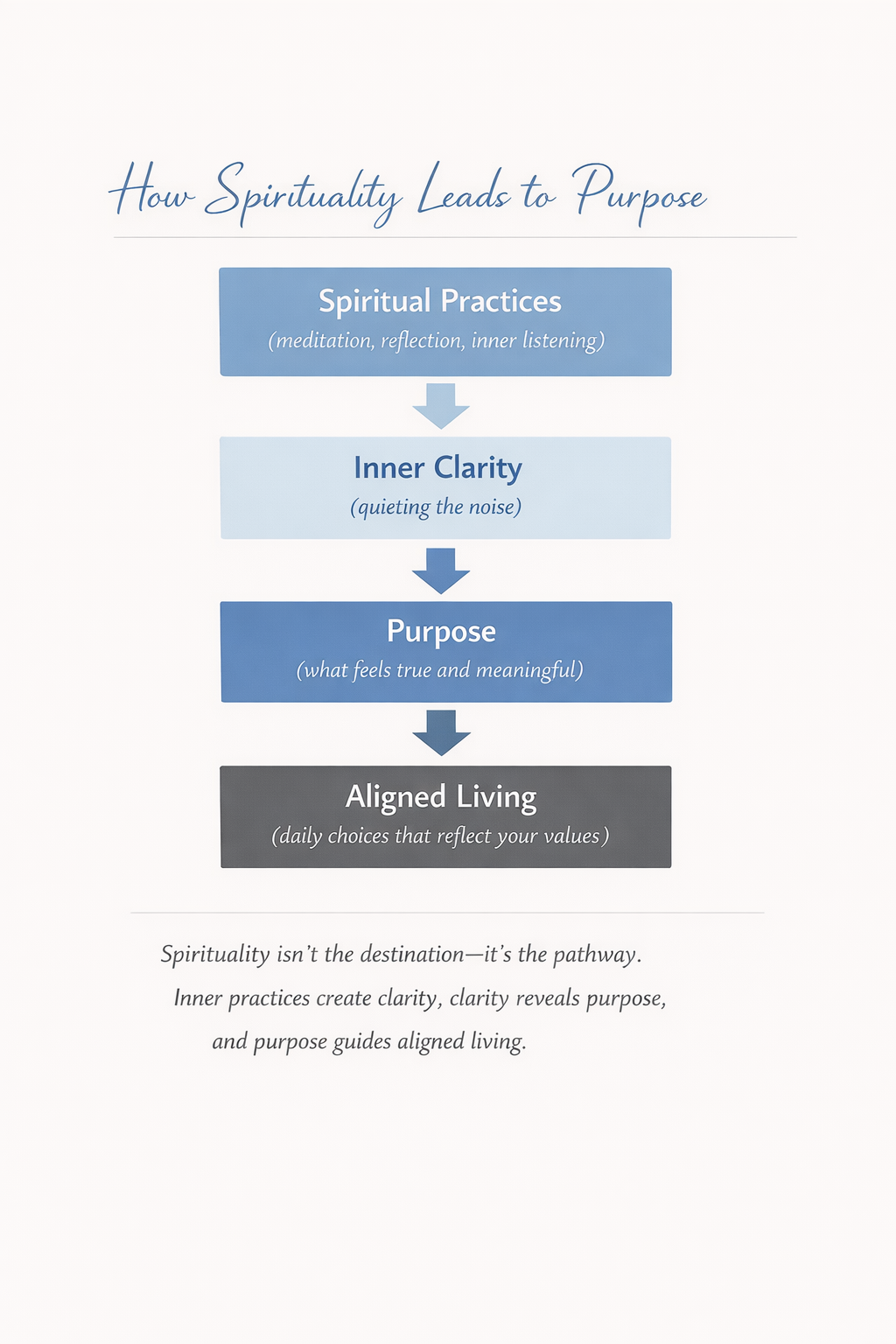
Spirituality is not the destination. It’s the pathway that helps you recognize what’s already inside you.
Many people confuse spiritual practice with purpose itself. They assume that meditating daily, reading spiritual books, or following a spiritual path is the end goal. But spirituality often serves a different role: it creates the inner space where your purpose can emerge.
Think of spirituality as the tool that clears away mental clutter. Your mind can fill with distractions, expectations from others, and old beliefs about who you “should” be. These layers of noise can bury what you’re truly meant to express. Spiritual practices—meditation, prayer, breathwork, or hypnosis—quiet the static so you can hear the whisper of your inner calling.
Your purpose isn’t something you have to force or chase. In many cases, it’s something you begin to recognize as you reconnect with your inner self. When you slow down and listen, the next right step becomes clearer.
This is also why spiritual hypnosis can be powerful. It helps you move beyond overthinking and drop into deeper awareness—where insight tends to feel calmer, clearer, and more “true.”
The relationship often works like this:
- Spirituality opens the channel
- Purpose becomes easier to recognize
- Your life becomes the expression of both
You don’t need to choose between them. Spirituality helps you hear your truth. Purpose helps you live it.
Understanding Purpose in Spirituality
Spiritual purpose connects your inner truth with your actions in the world. It gives you a framework for understanding why you’re here beyond survival, productivity, or external success—helping you build a life that feels aligned with who you really are.
Definition and Core Principles
Spiritual purpose reflects a unique calling rooted in your values, temperament, and deeper nature. It goes beyond what you do for work or how you spend your time. It’s the quality of who you are, and what you feel called to express through your life.
It often rests on a few core principles:
- It’s internal. Purpose is revealed from within—not assigned by society.
- It’s value-based. It aligns with what matters most to you beneath the noise.
- It’s connective. It links you to something larger—community, nature, the divine, or humanity.
Many people get clues about purpose by noticing when they feel most alive, honest, and connected to meaning. Those moments matter.
The Spiritual Meaning of Purpose
The spiritual meaning of purpose often includes the sense that your life has significance beyond achievement. From this view, you’re here to grow, to contribute, and to become more fully yourself.
Purpose becomes clearer as you track what feels fulfilling versus what feels empty. Patterns emerge. Certain themes repeat. You may notice you’re consistently drawn to healing, teaching, creativity, justice, connection, or building something meaningful.
For example:
- If your purpose is healing, you may naturally create calm and safety for others—without trying.
- If your purpose is truth, you may feel called to speak honestly, clarify confusion, or name what others avoid.
- If your purpose is service, you may feel most fulfilled when you’re contributing to something beyond yourself.
Distinguishing Spiritual Purpose from Material Goals
Material goals focus on external outcomes like income, recognition, or achievement. These goals can be helpful and important—but they don’t automatically create meaning. You can “do everything right” and still feel disconnected.
Spiritual purpose is different. It’s less about what you accumulate and more about what you embody. Less about status, more about alignment. Material goals support purpose when they help you live your values, express your gifts, and contribute in ways that feel true.
Pathways to Discovering Your Spiritual Purpose
Discovering purpose starts with listening inward—then letting that inner clarity shape your choices. The goal isn’t perfection. It’s honest connection.
Self-Discovery and Introspection
Self-discovery begins when you get curious about who you are beneath roles and expectations. Ask yourself what you believe, what you value, and what experiences shaped you. Pay attention to what brings you genuine energy—not just temporary excitement.
Try setting aside a few quiet minutes each day to tune into your inner voice. Notice what thoughts repeat, what feelings return, and what themes keep calling you back.
Clues often show up in patterns:
- What problems do you naturally want to solve?
- What do people come to you for?
- What makes you feel grounded and “like yourself”?
Reflective Practices and Journaling
Journaling creates a bridge between your conscious mind and deeper wisdom. Try writing freely—without editing—for 5–10 minutes. The purpose isn’t polished writing. It’s revealing what’s already there.
Helpful prompts include:
- “When do I feel most connected to meaning?”
- “What part of me wants to be expressed more fully?”
- “If I trusted myself completely, what would I do next?”
You can also pair journaling with a few minutes of stillness first—such as a short quiet meditation—so your writing comes from a calmer place.
Living in Alignment with Your Spiritual Purpose
Alignment happens in daily choices. It’s noticing what drains you, what nourishes you, and what feels honest—and then responding with small, steady shifts.
Aligning Actions with Core Values
Your values act like a compass. When you know what matters most, decisions become simpler.
Start by identifying your top five values—such as honesty, creativity, service, freedom, or connection. Then look at how you spend your time. Does your schedule reflect what you say matters?
Small choices often matter more than big declarations. Speaking truthfully in a hard conversation. Protecting your energy with a boundary. Choosing one supportive habit over self-abandonment. These are alignment practices.
The Smallest Next Step (Micro-Alignment)
If you feel overwhelmed or unsure, don’t try to “figure out your whole life.” Purpose often reveals itself through the next aligned step.
- Have one honest conversation you’ve been avoiding
- Say no to one thing that drains you
- Say yes to one thing that feels quietly true
- Do one small act of service (without overgiving)
- Create a 3-minute daily ritual: breath + hand on heart + intention
- Spend 10 minutes in nature, without your phone
These steps don’t just “improve your life.” They build trust with yourself—and that trust strengthens purpose clarity.
Embracing Authenticity and Integrity
Authenticity means living as your true self rather than performing for approval. Integrity means keeping small promises to yourself and honoring your inner guidance in real life.
When you stop pretending, you reclaim energy. That energy becomes available for healing, growth, and aligned living. Authenticity doesn’t mean sharing everything—it means being honest with yourself first.
As you live more genuinely, some relationships may shift. This can be part of the growth process. The connections that remain often deepen.
Maintaining Purpose Through Life Changes
Transitions can shake your sense of direction. During change, return to whatever helps you reconnect: stillness, ritual, reflection, community support, or guided inner work.
Your purpose may express itself differently across life stages. What alignment looked like at 25 may look different at 45—and both can be valid. What stays constant is your inner values and the essence of what you’re here to embody.
Spiritual Purpose vs. Career: Why They’re Not the Same Thing
Your spiritual purpose and your career can overlap, but they aren’t identical. Understanding this prevents pressure and opens more freedom.
Many people assume their job must be their purpose. That belief can create frustration and delay. Your career is one way to express purpose—not the only way.
Key Differences:
| Spiritual Purpose | Career |
|---|---|
| Internal calling that guides your life | External role you perform for income |
| Expressed through many areas of life | Often limited to work responsibilities |
| Rooted in values, growth, and contribution | Often shaped by market needs and skills |
| Can remain steady in essence | May change many times |
Your purpose might involve compassion, creativity, truth, or healing. You can express that through parenting, leadership, volunteering, friendship, art, or everyday interactions—whether or not your job title reflects it.
Don’t wait for the perfect career to begin living purposefully. Your purpose is available now, through how you show up and what energy you bring to your life.
Spiritual Practices and Tools for Purpose
Certain practices help you hear yourself more clearly by quieting external noise and strengthening inner connection. The goal isn’t to do them perfectly—it’s to create enough inner stillness for clarity to arise.
Inner Listening Practices That Reveal Purpose
Meditation builds the skill of noticing what’s true beneath thought loops. Even 5–10 minutes can help you recognize intuitive nudges and calmer insight.
Prayer can be another form of inner listening—especially when you include space for receiving, not just asking. You express what’s on your heart, then you pause and listen.
Breathwork, time in nature, and reflective stillness also count. What matters is the receptive quality: you’re making room for your deeper wisdom to speak.
When Spiritual Hypnosis Helps Most
Spiritual hypnosis can be especially supportive when you feel stuck in overthinking or disconnected from your intuition. It’s designed to help you access inner awareness more directly—so your guidance feels clearer and easier to trust.
People often explore spiritual hypnosis when:
- They feel lost or disconnected despite “doing all the right things”
- They repeat the same emotional patterns and want insight
- They struggle to quiet the mind in meditation
- They want guided inner connection and clarity
If you feel drawn to this kind of support, you can explore guided hypnosis audios or work one-on-one to deepen the process.
Visualization and Creative Expression
Visualization helps you “test” potential paths by feeling into them. Imagine living different scenarios and notice your body’s response—expansion, calm, excitement, heaviness, resistance. Your body often knows before your mind does.
Creative expression—writing, art, music, movement—can bypass analysis and reveal inner truth through symbols and themes. You don’t need talent. You need permission to create without judgment.
Community Service and Volunteering
Service reveals purpose through lived experience. When you contribute, you learn what energizes you and what drains you—information your mind can’t always predict.
Start small. Try one cause or community need. Pay attention to moments where you feel deeply satisfied, even if you’re tired. That “right kind of tired” can be a clue.
Relationships, Mentorship, and Spiritual Community
Your spiritual journey often deepens through supportive relationships. Connection provides perspective, accountability, and encouragement—especially when you feel unsure.
The Role of Spiritual Mentors
A mentor helps you see patterns, reflect honestly, and stay connected to your growth. The best mentors don’t hand you answers—they help you uncover your own. They ask good questions, offer tools, and support your unfolding with compassion.
In spiritual work, mentorship can also include learning to trust your inner guidance—whether you call that higher self, soul wisdom, or spiritual intuition.
Finding Support in Spiritual Communities
Healthy spiritual communities make it easier to stay consistent and feel less alone. Look for groups that welcome authentic questions, respect different paths, and encourage grounded growth.
Online communities can help you find like-minded people. In-person groups can offer deeper connection. Many people benefit from a mix of both.
Building Deeper Connections
Deep connections are built through honesty, consistency, and mutual care. A few meaningful relationships where you can be real will support your alignment more than a large circle of surface-level connection.
As you grow, relationships may shift. That isn’t always a loss. Sometimes it’s alignment in motion.
Overcoming Challenges and Fostering Growth
Challenges are part of the path. They don’t mean you’re failing—they often mean you’re changing. The key is learning how to return to your center and recognize when you’ve drifted.
Navigating Obstacles on the Spiritual Journey
Resistance can come through doubt, fear, old beliefs, or external pressure from people who don’t understand your path. Consistency can be hard when life is full.
When things feel difficult, simplify. Choose a “minimum viable practice” you can do even on messy days—three breaths, one journal page, one honest check-in with yourself.
Your trust in the process matters more than immediate certainty. Purpose clarity grows through repetition and relationship with your inner self.
Healing and Personal Transformation
Purpose becomes easier to live when you release patterns that keep you small. Through inner work—reflection, support, and guided practices—you can loosen the grip of old beliefs and respond to life with more freedom.
Self-compassion is essential here. Growth doesn’t require harshness. It requires honesty and gentleness.
As you heal, many people notice they feel more grounded, more emotionally steady, and more able to make aligned choices. These shifts can make purpose feel less like a mystery and more like a lived experience.
Sustaining Resilience and Well-Being
Resilience is your ability to return to alignment after you’ve drifted. It’s built through small consistent choices, supportive relationships, and practices that help you reconnect with your center.
Remember: spiritual growth isn’t separate from physical life. Rest, nourishment, movement, and boundaries support your inner clarity.
Signs You’re Disconnected From Your Spiritual Purpose
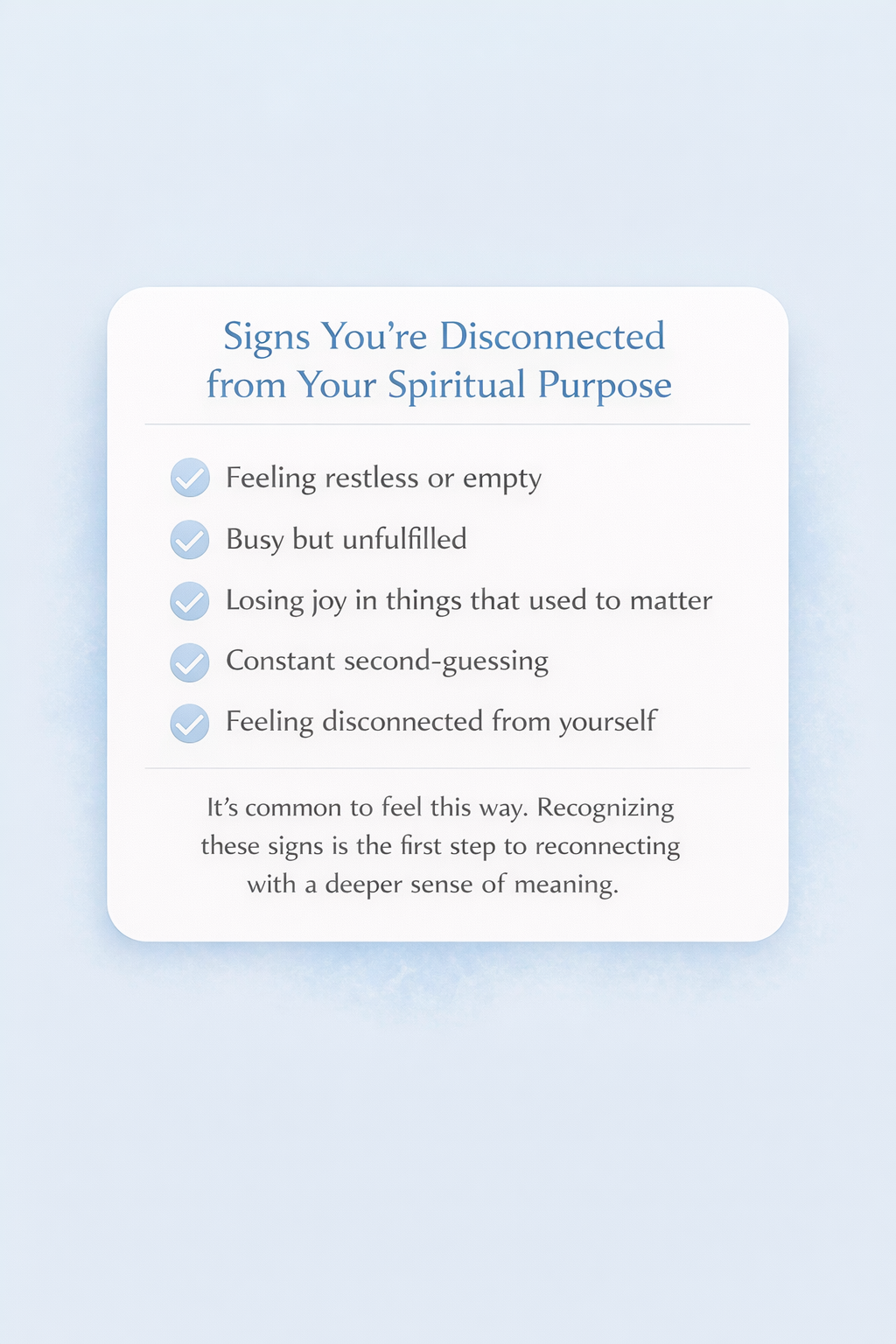
Disconnection can look like external “success” paired with inner emptiness. You may feel busy but unfulfilled, or like you’re always rushing without a deeper why.
Other signs can include:
- Loss of joy in things that used to matter
- Irritability or impatience that feels “not like you”
- Difficulty making decisions or trusting your intuition
- A sense of drifting, numbness, or going through the motions
Sometimes misalignment shows up as burnout signals—tension, overwhelm, or emotional fatigue. If you notice persistent physical symptoms, it’s always wise to seek appropriate professional support. Spirit and body work best as partners.
Purpose Across Spiritual and Secular Traditions
Different traditions offer different maps to meaning. Some people explore purpose through organized religion and the idea of divine guidance. Others follow a personal spiritual path rooted in mindfulness, self-inquiry, or inner connection outside formal institutions.
While the language varies, many paths share common ground: the desire to live with integrity, contribute in a meaningful way, and feel connected to something larger—whether that’s God, nature, humanity, or a sense of inner truth.
I work with clients from many backgrounds in spiritual hypnosis. Some come from strong faith traditions; others are secular seekers. The words may differ, but the deeper experience—listening inward, reconnecting, and choosing alignment—often feels surprisingly similar.
Your path is valid whether it flows through religion, personal spirituality, or a blend of both.
Frequently Asked Questions
People exploring purpose spirituality often share similar questions about meaning, direction, and how to live with intention.
What are common ways to identify one’s spiritual purpose?
Common approaches include reflection, journaling, meditation, and practices that support inner listening. Pay attention to what energizes you, what you value most deeply, and what themes keep returning throughout your life.
How does one’s spiritual purpose impact their overall well-being?
When your actions match your values, many people feel more grounded and clear. Alignment can reduce inner conflict and help daily life feel more meaningful—especially during stressful seasons.
Can astrology provide insights into discovering one’s soul purpose?
Astrology can be one framework for reflection. Many people find it helpful for identifying themes, strengths, and growth edges. It works best as a tool for inquiry rather than a fixed answer, since your choices and lived experience matter most.
What are the differences between soul purpose and spiritual purpose?
Soul purpose often refers to the specific themes, gifts, or contributions you’re here to express. Spiritual purpose can describe the broader journey of growth, connection, and alignment that supports that expression. You can think of soul purpose as the “what,” and spiritual purpose as the “why” and “how.”
In what ways can we interpret the concept of soul purpose across different cultures?
Many Eastern traditions frame purpose through concepts like dharma and karma. Indigenous cultures often emphasize purpose as relationship—community, land, and balance. Many Western frameworks focus on self-actualization and personal meaning. Different maps, similar longing: to live a life that matters.
How might exploring spirituality assist in clarifying life goals and direction?
Spiritual practices help you quiet external noise so you can distinguish between what you truly want and what you’ve been conditioned to pursue. Over time, you begin choosing goals that match your values and deeper nature.
What if I don’t feel called to anything specific?
Not everyone experiences a dramatic calling. Many people discover purpose gradually through small aligned choices. Your purpose may be less about one “thing” and more about how you show up—through presence, compassion, creativity, service, or truth—expressed in different ways across your life.
