

Many people eventually begin wondering how to find your purpose and passion in life, especially during moments when something feels missing or uncertain. It might happen during a career transition, after a major life change, or simply during a quiet moment of reflection when you start asking deeper questions about meaning and direction.
For many people, the search for purpose can feel overwhelming because purpose and passion are often talked about as if they are exactly the same thing. People assume that once they discover their passion, their purpose will automatically become clear.
But purpose and passion are not always identical.
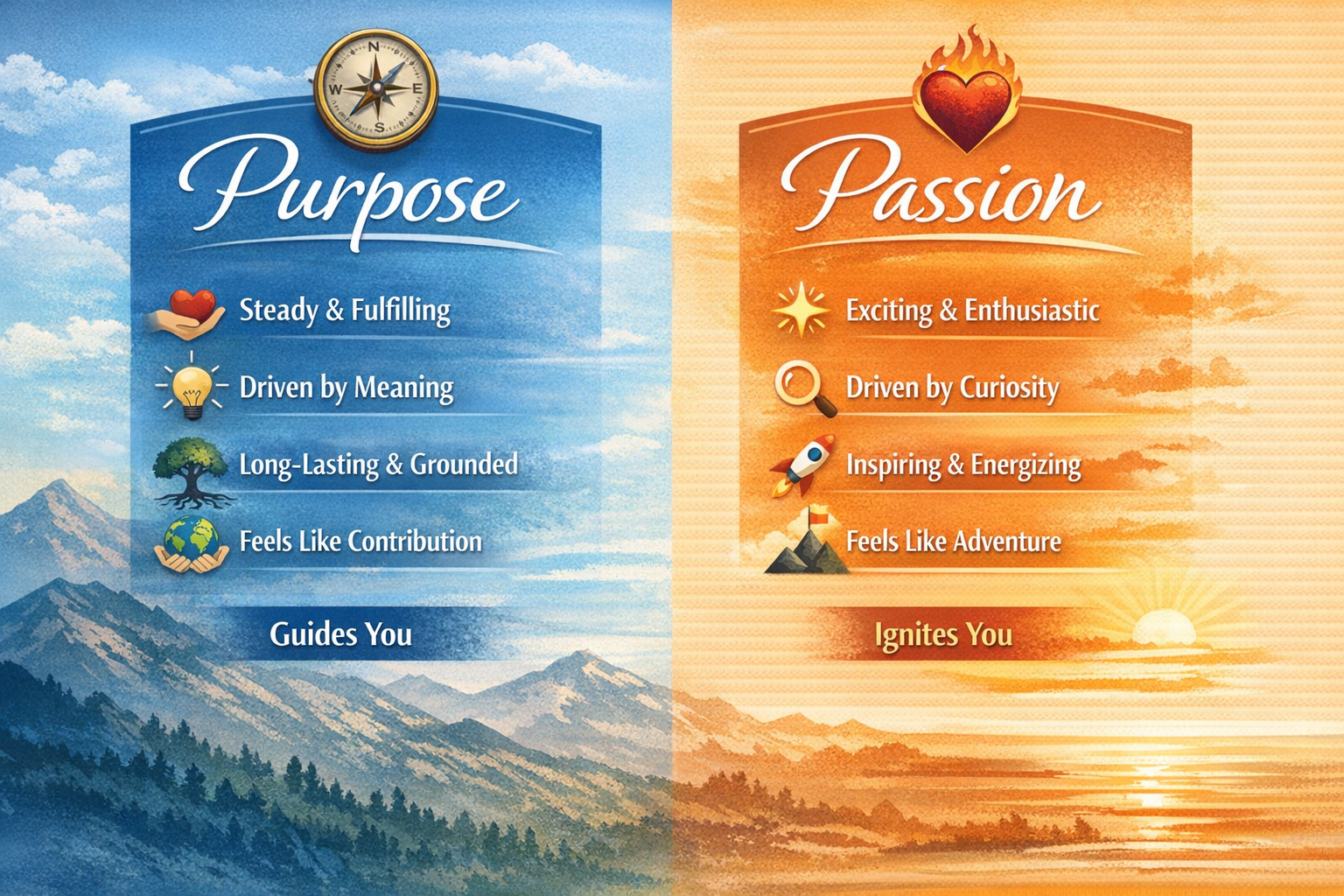
Passion often feels exciting. It can spark curiosity, creativity, or enthusiasm for something that energizes you. It may create a sense of excitement and longing that pulls you toward a particular interest or activity.
Purpose feels different.
Purpose is steadier. It brings a sense of fulfillment and satisfaction that can remain even when something requires effort, patience, or growth. Passion can rise and fall over time, but purpose tends to stay rooted much deeper.
Sometimes passion and purpose align beautifully. Other times they exist separately, and that is completely normal.
As a Certified Hypnotist and founder of Intuitive Clarity Hypnosis, I often work with people who feel uncertain about direction in life. Many assume they need to discover one perfect passion that explains everything about who they are meant to do or become.
In reality, purpose usually reveals itself gradually through experience, reflection, and self awareness. Sometimes people reconnect with that deeper sense of direction by looking inward instead of searching only outside themselves. Practices like reflection, meditation, or guided sessions such as my hypnosis services can help people access deeper insight and reconnect with their inner guidance.
Purpose rarely appears overnight.
More often, it becomes clearer when you begin to notice the patterns, values, and experiences that have been shaping your life all along.
What Is the Difference Between Purpose and Passion?
One of the biggest reasons people struggle when trying to figure out how to find your purpose and passion in life is because the two ideas are often treated as if they are identical.
They are related, but they are not always the same.
Passion is usually emotional and energizing. It is the excitement you feel when you are doing something that interests you deeply. Passion can make you feel inspired, creative, and motivated. It often shows up as curiosity or enthusiasm for an activity, idea, or subject.
Purpose feels different.
Purpose tends to be steadier and more grounded. It is the sense that what you are doing has meaning and contributes something valuable to the world around you.
Someone might feel passionate about photography, traveling, or learning new skills. Those interests can bring joy and excitement. But their deeper purpose might involve helping people, teaching others, guiding someone through a difficult experience, or sharing wisdom gained over time.
Passion can change as people grow and move through different stages of life.
Purpose often grows stronger with experience.
The psychiatrist Viktor Frankl wrote extensively about this idea in Man’s Search for Meaning. His work suggested that people often find lasting fulfillment through meaning and contribution rather than through constant excitement or pleasure.
In other words, passion may energize you.
Purpose tends to sustain you.
When passion and purpose align, people often feel both energized and fulfilled. But it is important to understand that they do not always need to match perfectly for your life to feel meaningful.
Recognizing the difference between the two can make the search for direction feel much less overwhelming.
Why Finding Your Purpose in Life Matters
When people begin thinking about how to find your purpose and passion in life, they are usually searching for more than just a career direction.
They are searching for meaning.
Purpose gives direction to your life. It helps guide decisions, relationships, and the way you spend your time and energy. Without a sense of purpose, people often feel restless or disconnected, even if things appear successful from the outside.
Purpose acts like a compass.
It may not tell you every step to take, but it helps you recognize when something feels aligned and when it does not.
Psychiatrist Viktor Frankl believed that meaning is one of the most powerful forces guiding human behavior. Through his work in logotherapy, he observed that people who feel a sense of purpose are often more resilient and able to navigate difficult experiences with greater strength.
Purpose does not eliminate challenges.
It helps people understand why those challenges matter.
Research on wellbeing and life satisfaction often shows a similar pattern. Studies referenced by organizations such as AARP suggest that individuals who feel a sense of purpose tend to experience greater life satisfaction and emotional wellbeing.
Purpose creates a deeper connection between your experiences and the world around you.
Sometimes that purpose shows up through helping others, sharing knowledge, mentoring, or guiding people through situations you have already lived through. Many people discover that the lessons they once struggled with eventually become something they can use to support others.
This is something I see frequently when working with clients through spiritual hypnosis sessions or personalized guidance through hypnosis services. People often arrive thinking they need to completely reinvent themselves.
Instead, they begin recognizing that many of the experiences they have already lived contain important clues about their purpose.
Purpose rarely appears as a dramatic moment of realization.
More often, it becomes clearer as you start paying attention to what feels meaningful, what draws your curiosity, and how your experiences have shaped the way you understand the world.
Over time, those pieces begin to form a clearer direction.
Signs You May Be Searching for Your Purpose
Many people do not wake up one day and suddenly decide to search for their purpose.
More often, the feeling grows slowly.
Something begins to feel slightly out of alignment. Life may look successful on the outside, but internally there is a quiet sense that something more meaningful might be waiting to unfold.
This feeling can appear during major life transitions.
A career change.
A relationship shift.
Retirement.
A personal loss or moment of spiritual growth.
These experiences create space for reflection, and that space often brings deeper questions about identity and direction.
Psychologist Carl Jung believed that periods of questioning are an important part of personal growth. He described these moments as opportunities for deeper self discovery rather than problems to be solved.
When people begin wondering how to find your purpose and passion in life, they often notice certain patterns.
You may feel restless even when things seem stable.
You may begin asking deeper questions about meaning, fulfillment, or contribution.
You might find yourself more interested in personal growth, spirituality, or understanding your life experiences in a new way.
Sometimes people also start noticing that what once motivated them no longer feels as important.
That shift can feel confusing at first.
In reality, it is often a sign that your priorities are evolving.
Many people begin exploring these questions through journaling, meditation, coaching, or introspective practices like past life regression hypnosis or other forms of guided reflection. These experiences can help people recognize patterns in their lives and understand how their experiences have shaped who they are becoming.
Feeling uncertain about your purpose does not mean you are lost.
Often it means you are beginning to look at your life more consciously.
And that awareness is usually the first step toward discovering deeper meaning and direction.
Practical Ways to Discover Your Purpose and Passion
When people start exploring how to find your purpose and passion in life, they often expect a single moment of clarity where everything suddenly makes sense.
In reality, purpose usually unfolds over time.
It grows through experience, reflection, and paying attention to the patterns that have shaped your life.
Here are a few ways to begin exploring it.
Reflect on What You Care About Most
Your interests often reveal deeper values.
Think about the topics or issues that naturally capture your attention. These may be things you read about, talk about often, or feel emotionally connected to.
Purpose often grows from values that matter deeply to you.
When people start noticing these patterns, they begin to understand what gives their life meaning beyond everyday responsibilities.
Look for Patterns in Your Life
Purpose rarely appears out of nowhere.
More often, it leaves clues throughout different stages of life.
Think about the roles you naturally step into.
Are you someone who helps people solve problems?
Do friends and family come to you for advice?
Do you feel drawn to guiding, teaching, or supporting others?
Psychologist Erik Erikson described this desire to guide and support others as part of a stage of life called generativity. It reflects a natural human drive to contribute something meaningful to the next generation.
When you start noticing these patterns, you may begin to see how your experiences connect to a deeper purpose.
Notice Where You Feel Most Useful
Purpose often appears in moments when you feel helpful or impactful.
This does not always mean doing something dramatic or world changing.
Sometimes it is as simple as sharing wisdom, offering encouragement, or helping someone see a situation from a new perspective.
People frequently discover purpose through service and contribution.
The things that make you feel useful can often reveal where your natural strengths are meant to be applied.
Pay Attention to What Feels Meaningful
Passion can feel exciting and energizing.
Purpose often feels meaningful and grounding.
Something meaningful may not always bring immediate excitement, but it creates a sense of fulfillment that lasts longer.
This is why passion and purpose do not always look the same.
Passion can inspire curiosity and enthusiasm.
Purpose tends to create a deeper sense that what you are doing matters.
Over time, those meaningful experiences often become clearer signals pointing toward the direction you are meant to grow.
Explore Your Inner Guidance
Many people spend years searching externally for their purpose when the answers are often found internally.
Reflection practices such as journaling, meditation, or hypnosis can help people access insights that are harder to reach through analytical thinking alone.
Through guided sessions such as spiritual hypnosis or other hypnosis services, people often begin recognizing patterns in their life experiences and understanding how those experiences connect to their deeper motivations.
When people allow themselves to slow down and listen inwardly, purpose often becomes clearer.
It is rarely something you force.
More often, it is something you begin to recognize once you start paying attention.
Questions That Can Help You Find Your Purpose
Sometimes the most powerful way to discover purpose is not by searching harder, but by asking better questions.
Purpose tends to reveal itself when people slow down and begin reflecting on their experiences, values, and strengths. Instead of trying to force an answer, it can be helpful to explore the patterns that have shaped your life.
Here are a few questions that can help guide that reflection.
What wisdom have I gained that others could benefit from?
Every experience in life teaches something. Challenges, successes, relationships, and even mistakes all create insight over time. Many people discover that their purpose is connected to sharing lessons they have already lived through.
What do people naturally come to me for advice about?
Often, purpose is connected to the role you naturally play in the lives of others. Some people are natural problem solvers. Others are listeners, mentors, or guides. Paying attention to these patterns can reveal strengths that may point toward meaningful direction.
What did I never have time for earlier in life?
Life responsibilities can sometimes delay interests that feel deeply meaningful. When people finally create space for those interests, they often discover parts of themselves that were waiting to be explored.
What feels meaningful even if it does not bring recognition or income?
Purpose is not always tied to achievement or status. In many cases, purpose grows from activities that feel deeply fulfilling regardless of external reward.
Psychologist Carl Jung often emphasized the importance of self reflection when exploring deeper identity and meaning. By looking inward and examining personal experiences, people begin to understand the themes that have shaped who they are.
Taking time to reflect on questions like these can reveal insights that are easy to overlook in the busyness of everyday life.
Sometimes the answers appear quickly.
Other times they unfold gradually.
But the act of asking these questions often begins the process of discovering direction, meaning, and purpose.
How Hypnosis Can Help You Discover Your Purpose
Sometimes people try to think their way to clarity.
They analyze possibilities, weigh options, and search for the perfect answer. But purpose is not always something the logical mind can solve like a puzzle.
Often it is something you begin to recognize when you become quieter and more reflective.
Hypnosis can help create that space.
Hypnosis is a natural state of focused awareness that allows the analytical mind to relax while deeper insight becomes easier to access. When the constant noise of everyday thinking settles down, people often notice thoughts, memories, and ideas that were already present but harder to hear.
Through this process, many people begin recognizing patterns that point toward their purpose.
As a Certified Hypnotist and founder of Intuitive Clarity Hypnosis, I often work with clients who want to understand their life direction more clearly. Many arrive feeling uncertain about what they are meant to do or how to reconnect with the sense of meaning they once felt.
During sessions, people often explore questions about identity, values, and life themes that have followed them across different stages of life.
Some people choose to explore these questions through guided experiences like spiritual hypnosis, which focuses on connecting with intuition, inner wisdom, and a deeper sense of guidance.
Others explore insights through experiences such as past life regression hypnosis, where people often gain perspective on recurring themes, lessons, or motivations that appear throughout their life journey.
Hypnosis does not give people a scripted answer about their purpose.
Instead, it helps them access their own inner understanding.
When people begin to see their experiences, values, and motivations from a deeper perspective, purpose often becomes clearer.
It is rarely something that suddenly appears.
More often, it is something that begins to make sense once people recognize the meaning that has been present in their life all along.
Purpose Can Evolve Throughout Your Life
One of the most important things to understand when exploring how to find your purpose and passion in life is that purpose is not fixed.
It changes as you grow.
Many people believe that purpose is something you discover once and then follow for the rest of your life. In reality, purpose often evolves as your experiences, priorities, and understanding of yourself change.
Early in life, purpose may focus on learning, building a career, or creating stability.
Later, it may shift toward mentorship, contribution, creativity, or spiritual growth.
Psychologist Erik Erikson described this shift as part of a natural stage of human development called generativity. During this stage, people begin to feel a stronger desire to guide others, share knowledge, and contribute to the next generation.
This is why purpose often becomes clearer as people gain life experience.
The lessons you have learned.
The challenges you have overcome.
The perspectives you have developed.
All of these experiences shape how you understand the world and how you can contribute to it.
Purpose grows through those experiences.
Sometimes people realize that what once felt important no longer feels aligned. That does not mean they were on the wrong path.
It simply means their understanding of themselves is expanding.
Purpose evolves because you evolve.
As people become more self aware, they often begin to see how their experiences connect to a deeper sense of meaning. The things they once struggled through may eventually become the insights they share with others.
Over time, purpose begins to feel less like something you have to search for and more like something you gradually grow into.
Living With Both Purpose and Passion
Passion and purpose can work beautifully together, but they do not always appear at the same time.
Passion often brings energy.
Purpose brings meaning.
Passion may show up as curiosity, excitement, or creativity around something that interests you. It can inspire exploration and new experiences.
Purpose tends to be quieter.
It creates a sense that what you are doing matters. Even when something requires patience or effort, purpose provides the motivation to continue.
When passion and purpose align, people often feel energized and fulfilled at the same time.
But even when passion changes, purpose can remain steady.
Understanding this difference helps remove a lot of pressure from the search for direction. Instead of trying to find one perfect answer, people can begin paying attention to what feels meaningful, what sparks curiosity, and how their experiences might contribute to others.
Over time, those pieces often begin to align naturally.

Finding Purpose and Passion…Final Thoughts
Finding your purpose and passion in life is not about discovering one perfect path.
It is about understanding yourself more deeply.
Purpose often reveals itself through experience, reflection (through life purpose coaching if you choose), and the recognition of your values, strengths, and lessons. Passion may guide exploration and creativity, but purpose creates the deeper sense that what you are doing matters.
Sometimes the journey begins with curiosity.
Other times it begins with uncertainty.
But as people start paying attention to the patterns in their life and the ways they naturally contribute to others, direction often becomes clearer.
Instead of asking What am I supposed to do with my life?
The question slowly changes.
How can I use who I am to make a meaningful difference?
And that is often where purpose truly begins.
