

Spirit Guides
Spirit Guides and Inner Guidance
A grounded look at how spiritual guidance is commonly experienced, what spirit guides actually do, and how inner guidance shows up through awareness, intuition, and reflection.
Most people have experienced moments of quiet knowing at some point in their lives. You might suddenly feel certain about a decision, sense that something no longer feels right, or notice repeated signs that gently get your attention. These experiences are often described as inner guidance, intuition, or spiritual support. For some people, they are understood through the idea of spirit guides.
This page is not here to convince you of anything or ask you to believe a certain way. Instead, it offers a grounded look at how spiritual guidance is commonly experienced, how people understand spirit guides in different ways, and how inner guidance often shows up through awareness, intuition, and reflection.
You do not need to consider yourself spiritual to relate to this. Whether you are curious, reflective, or simply trying to understand your own inner experiences, learning how guidance works can help you trust yourself more and move through life with greater clarity.
Quick Answer
Spirit guides are commonly understood as sources of support that help with direction, spiritual growth, and a sense of protection — but the way people experience that support varies widely. Some understand it as external spiritual beings; others experience it as intuition, subconscious insight, or inner knowing. Genuine guidance tends to feel calm, steady, and non-urgent, and it supports your own judgment rather than replacing it.
In This Article
- Why people experience guidance in the first place
- What are spirit guides? And what are they not
- What do spirit guides do?
- Inner guidance vs. spirit guides
- How spiritual guidance shows up in everyday life
- Imagination vs. guidance: a grounded perspective
- How inner guidance connects to purpose and healing
- Practices that help you hear inner guidance
- When people feel disconnected from guidance
- Explore deeper questions about spirit guides
- Who this exploration is for (and not for)
- Frequently asked questions
Why People Experience Guidance in the First Place
Human beings naturally look for meaning and direction. We want to understand what feels right, what feels off, and where our energy is best placed. Long before modern psychology or spiritual language existed, people relied on intuition, reflection, and inner awareness to guide decisions.
Guidance does not usually arrive as something dramatic. It often shows up quietly, as a feeling, a realization, or a sense of clarity that seems to come from nowhere. When the mind slows down, deeper awareness has room to surface.
Many people notice guidance most clearly during times of change. This might include shifts in relationships, work, health, or identity. When life feels uncertain, attention naturally turns inward. That inward focus creates space for insight.
Guidance also does not require belief. Some people call it intuition. Others call it inner wisdom or gut instinct. Some describe it spiritually, while others see it as psychological or emotional awareness. The language may differ, but the experience itself is very human and very common.
What Are Spirit Guides? And What Are They Not
What People Mean by Spirit Guides
When people talk about spirit guides, they are usually describing a sense of support that feels personal and reassuring. Some understand spirit guides as spiritual beings or helpers. Others see them as a symbolic way of relating to intuition, subconscious insight, or higher awareness.
There is no single definition that applies to everyone. What matters most is how the idea functions in a person’s life. For many people, thinking in terms of spirit guides helps them slow down, listen inward, and approach decisions with more care and awareness.
Spirit guides are often experienced as supportive rather than directive. They are not meant to replace your judgment or decision making. Instead, they encourage self trust and personal insight.
What Spirit Guides Are Not
Spirit guides are not controlling forces. They do not tell you what to do, make decisions for you, or override your free will. Genuine guidance does not feel urgent, frightening, or pressuring. It does not ask you to ignore logic, safety, or personal responsibility.
Spiritual guidance is also not a replacement for medical, mental health, or professional care. It does not diagnose conditions, predict outcomes, or offer guarantees. Instead, it supports awareness by helping you notice patterns, emotions, and areas of alignment or misalignment in your life.
When understood in a grounded way, spirit guides are not something to fear or blindly follow. They are one of many ways people relate to inner awareness and the quiet signals that support clarity, growth, and understanding.
What Do Spirit Guides Do?
Within that grounded framework, people generally describe this kind of support falling into three broad roles.
Offering Direction and Support
The most commonly described role is helping bring clarity during confusing or difficult moments — a repeated sign, a sudden insight, or a strong feeling about which direction to take. This is also where people describe emotional support: a reminder of inner strength, or a sense of staying connected to what matters when things feel hard.
Supporting Growth
Many people describe this support as showing up around growth — being drawn toward a book, a teacher, or an experience right when they needed it, or gradually becoming aware of a pattern that no longer serves them. This role is less about answers and more about the conditions that make self-understanding possible.
A Sense of Protection
People also commonly describe a protective quality — an unexplained hesitation about a place or situation, or a sense of being looked after during vulnerable moments like rest or difficult transitions. Whether understood spiritually or as a form of heightened intuition, this is one of the most consistently reported experiences.
Worth Naming
Not every coincidence carries meaning, and expecting dramatic signs often leads to disappointment. Most people describe this kind of guidance as feeling natural and calm rather than overwhelming — and it’s just as easy to mistake an ordinary thought for something more, or to expect guidance to solve a problem you still need to act on yourself.
Inner Guidance vs. Spirit Guides
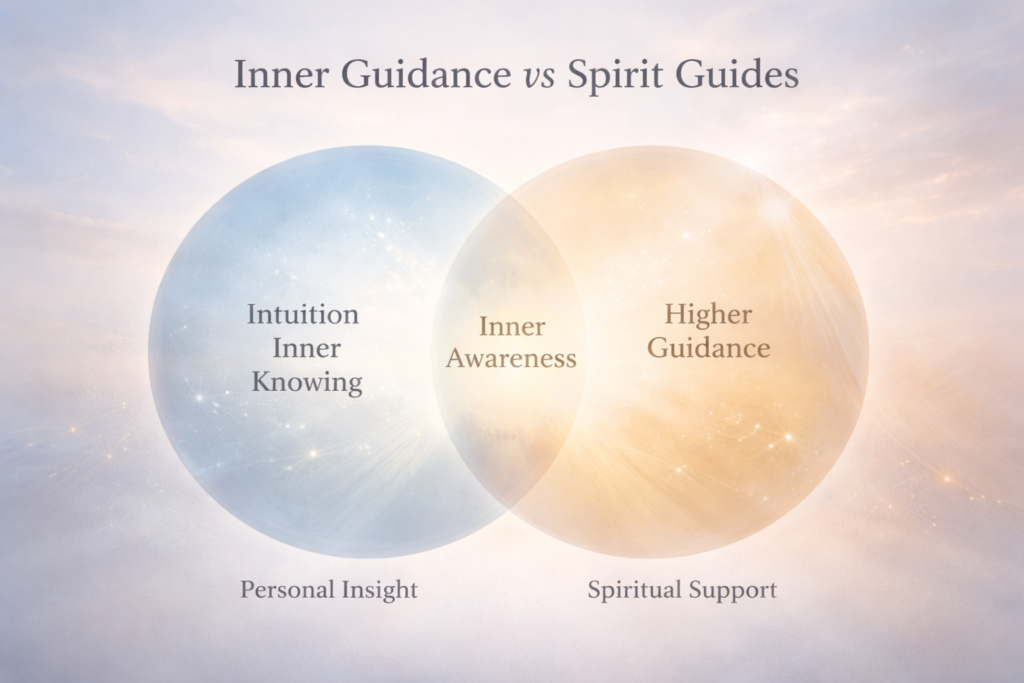
Inner guidance is often experienced as intuition, which many people describe as a felt sense of knowing that does not rely on logical explanation.
People often wonder whether inner guidance and spirit guides are the same thing or if they are different experiences. The answer is that they are closely related, but not always understood in the same way.
Inner guidance is usually described as intuition, inner knowing, or a felt sense of clarity. It may show up as a quiet thought, a feeling in the body, or a gentle sense of certainty. Inner guidance feels personal because it arises within your own awareness.
Spirit guides are one way people understand where that guidance comes from. Some see spirit guides as external spiritual helpers, while others see them as a symbolic way of relating to deeper wisdom or higher awareness. In practice, many people experience spirit guides through their inner guidance rather than as something separate from themselves.
In everyday life, this means that guidance does not usually arrive as a voice or instruction. It comes through awareness. A sense of peace about a choice. A feeling of resistance when something is not aligned. A moment of clarity that feels calm and steady rather than emotional or reactive.
For many people, inner guidance is the doorway. Spirit guides are the language they use to make sense of that experience. Neither approach is better than the other.
How Spiritual Guidance Shows Up in Everyday Life

Spiritual guidance is often subtle. It does not usually announce itself or demand attention. Most people recognize guidance only in hindsight, when they look back and realize they felt nudged in a certain direction long before they understood why.
One common way guidance shows up is through a feeling in the body. This might feel like ease, tension, openness, or hesitation. These sensations are often the body’s way of communicating alignment or misalignment before the mind catches up.
Guidance can also appear as repeated thoughts or themes that gently return to your awareness. You might keep thinking about a particular idea, opportunity, or change without forcing it. Over time, the repetition itself becomes information.
Some people notice guidance through signs or synchronicities. This can include seeing the same message repeatedly, encountering meaningful coincidences, or feeling drawn to certain information at the right moment. These experiences are not about prediction or control. They are about attention and reflection.
Clarity is another common form of guidance, such as finally feeling a calling to do something in your life when you weren’t sure about it before. This may arrive suddenly, but more often it emerges after rest, reflection, or quiet time. When the mental noise settles, answers that were already present become easier to recognize.
What guidance does not usually feel like is urgency, fear, or pressure. Genuine guidance feels steady and supportive. It allows space for choice and reflection. It does not rush you or override your reasoning.
Many people worry that they are missing guidance because it feels too subtle. In reality, subtlety is often the sign that guidance is working as it should. It respects your autonomy and supports your ability to choose rather than telling you what to do.
Imagination vs. Guidance: A Grounded Perspective
One of the most common concerns people have is whether they are imagining guidance or actually experiencing it. This question alone shows a healthy level of self awareness. It means you are thinking critically rather than blindly believing everything that comes to mind.
Imagination is not a problem. In fact, imagination is one of the ways the subconscious communicates. Images, symbols, memories, and ideas often surface through imagination because that is how the mind processes deeper information. This does not make the experience meaningless or untrustworthy.
Guidance does not need to arrive in a literal or dramatic way to be valid. It often shows up as a feeling, a symbol, or a quiet realization that helps you see something more clearly. The usefulness of the experience matters more than whether it feels mystical or ordinary.
A Useful Test
A helpful way to think about this is to ask how the information feels and what it supports. Genuine guidance tends to feel calm, steady, and reassuring. It does not rush you, scare you, or pressure you into action. It leaves room for choice and reflection. Imagination driven by fear usually feels different — urgent, loud, or emotionally charged. It pushes instead of invites.
You do not need to label every inner experience as guidance. Sometimes reflection is simply reflection. Sometimes imagination is creative processing. Over time, as you become more familiar with your own inner landscape, it becomes easier to recognize what feels supportive and aligned for you.
How Inner Guidance Connects to Purpose and Healing
Inner guidance plays a quiet but important role in both purpose and healing. It does not hand you a life plan or offer instant answers. Instead, it helps you notice what feels aligned, what feels draining, and what no longer fits the person you are becoming.
Purpose often becomes clearer through contrast. Inner guidance helps you recognize when something feels off, even if it looks fine on the surface. That awareness is valuable. It points you toward choices that feel more authentic rather than forcing you to stay in patterns that no longer serve you.
Healing works in a similar way. Before change happens, awareness comes first. Inner guidance brings attention to emotional patterns, reactions, and beliefs that may be operating automatically. Once something is seen clearly, it becomes easier to respond differently.
Guidance does not push you to fix yourself. It encourages understanding. Many people find that when they listen inward with curiosity instead of judgment, emotional shifts happen naturally over time. This gentle awareness supports healing without force or pressure.
As people become more connected to their inner guidance, they often report feeling more grounded and confident in their decisions. They rely less on outside approval and more on their own sense of clarity. This self trust supports both personal growth and emotional well being.
In this way, guidance is not about receiving answers from outside yourself. It is about learning to recognize what your own awareness has been communicating all along.
Practices That Help You Hear Inner Guidance
Inner guidance becomes easier to notice when the mind has space to slow down. You do not need special abilities or rigid routines. What matters most is creating moments where you can tune inward without distraction or pressure.
Stillness and Reflection
Stillness does not have to mean sitting in silence for long periods of time. It can be as simple as a few quiet minutes in the morning, a short walk without your phone, or pausing before making a decision to check in with how something feels.
Reflection allows insights to surface naturally. Journaling is a helpful way to do this because it gives your thoughts somewhere to land. Writing without editing or overthinking often reveals patterns, feelings, and clarity that were not obvious at first.
Meditation can also support inner listening, but it does not need to be perfect. Even brief moments of focused breathing or gentle awareness can help calm mental noise. The goal is not to empty your mind, but to soften it enough that awareness has room to come through.
Over time, these simple practices strengthen your relationship with your own inner signals. You begin to recognize what feels steady and aligned versus what feels reactive or draining.
Hypnosis as a Supportive Tool
Hypnosis can be a gentle way to support inner listening, especially for people who find it difficult to quiet their thoughts. Rather than forcing relaxation, hypnosis helps the mind settle into a focused and receptive state where awareness can deepen naturally.
In this state, the constant mental chatter tends to soften. This makes it easier to notice feelings, insights, and patterns that are already present beneath the surface. Hypnosis does not put anything into your mind or take control away from you. It supports access to your own inner awareness.
Many people use hypnosis as a way to reconnect with intuition, reflect on emotional patterns, or gain clarity during times of transition. It works best as a supportive practice rather than a source of answers. The insight still comes from within you.
When People Feel Disconnected From Guidance
Feeling disconnected from inner guidance is very common, especially during stressful or emotionally demanding periods of life. This does not mean guidance has disappeared. It usually means attention has been pulled outward for survival, problem solving, or coping.
Stress is one of the biggest reasons people feel disconnected. When the nervous system is overwhelmed, the mind focuses on urgency and control. This leaves little space for subtle awareness. Overthinking can have a similar effect. When thoughts are constant and loud, quieter signals are harder to notice.
Life transitions can also create a sense of disconnection. Changes in relationships, work, health, or identity often bring uncertainty. During these times, people may doubt themselves more or feel unsure about what direction to take.
Reconnection does not require effort or force. In fact, trying too hard often makes it more difficult. Inner guidance returns naturally when there is permission to slow down, reflect, and listen without expectation.
It helps to remember that guidance is not something you lose. It is something you temporarily stop noticing. Small moments of awareness, rest, and self compassion are often enough to reopen that connection.
There is no right pace for this process. Some people reconnect quickly. Others do so gradually. Both are normal. What matters is allowing the process to be gentle and respectful of where you are.
Explore Deeper Questions About Spirit Guides
As you begin to understand how inner guidance and spiritual support show up in your life, you may find yourself curious about more specific questions. Many people wonder what spirit guides actually are, how guidance works, or whether these experiences are something everyone has.
If you would like to explore these topics more deeply, the following articles take a closer look at common questions and experiences related to spirit guides and inner guidance:
- ✦Are Spirit Guides Real?
- ✦What Do Spirit Guides Look Like?
- ✦Does Everyone Have a Spirit Guide?
- ✦How to Talk With Your Spirit Guides
- ✦Signs From Spirit Guides
Each article focuses on a specific aspect of spiritual guidance and is meant to support reflection rather than provide rigid answers. You can explore any topic that resonates with you, in any order. There is no right way to approach this work. Curiosity and openness are enough.
Who This Exploration Is For (and Not For)
Exploring spirit guides and inner guidance can be meaningful, grounding, and supportive for many people. This page is meant for those who are curious about their inner experiences and want to understand them in a thoughtful, balanced way.
This May Be Helpful If You
- ✓Enjoy reflection and self awareness
- ✓Are curious about intuition, inner knowing, or spiritual insight
- ✓Want to understand your experiences without feeling pressured to believe anything
- ✓Value personal growth, clarity, and emotional understanding
This Is Not Meant For
- –Situations that require urgent or emergency care
- –Seeking predictions, guarantees, or instructions about the future
- –Replacing medical, mental health, or professional support
- –Handing decision making power over to external sources
Inner guidance is meant to support clarity and self trust, not replace responsibility or professional care. If you are experiencing distress or crisis, reaching out to appropriate support is always the most important step.
✦ ✦ ✦
Services at Intuitive Clarity Hypnosis are for educational and personal development purposes only and are not intended to diagnose, treat, cure, or prevent any medical or mental health condition. Hypnosis and coaching are complementary and not substitutes for licensed care. Please consult a qualified healthcare provider for medical or psychological concerns. Read full disclaimer.
Frequently Asked Questions
What do spirit guides do?
People commonly describe three broad roles: offering direction and support during confusing moments, supporting personal growth by drawing attention to helpful patterns or opportunities, and providing a sense of protection during vulnerable or difficult times.
Is inner guidance the same thing as a spirit guide?
They’re closely related but not always understood the same way. Inner guidance is usually described as intuition or a felt sense of knowing. Spirit guides are one way people make sense of where that guidance comes from — some as external beings, others as a symbolic way of relating to deeper wisdom or higher awareness.
How many spirit guides does a person typically have?
This varies by belief system and individual. Many spiritual teachers describe at least one primary guide who stays consistently, with additional guides coming and going based on specific life situations such as career, relationships, or health.
Can spirit guides manifest in human form?
Most descriptions hold that spirit guides are non-physical and don’t take on a literal human form, though some people report guides working through other people who say exactly what’s needed at the right moment, or appearing as human figures in dreams.
Do I need to believe in spirit guides for this to be useful?
No. This exploration works whether you understand these experiences spiritually, psychologically, or simply as intuition. What matters is whether reflecting on your own inner guidance helps you feel clearer and more self-trusting — not which framework you use to describe it.
How do I know if something is genuine guidance or just imagination?
Genuine guidance tends to feel calm, steady, and reassuring, and it leaves room for choice and reflection rather than pushing or pressuring you. Imagination driven by fear tends to feel urgent, loud, or emotionally charged. The usefulness and feeling of the experience matters more than whether it seems mystical or ordinary.
Ready to Explore Your Own Inner Guidance?
If you’d like support reconnecting with your intuition through hypnosis and intuitive guidance, I offer sessions online and in person in Virginia Beach.
